


Feed aggregator
Weekly discussion, complaint, and rant thread
Open to anything, including discussions, complaints, and rants.
Sub rules do not apply, so don't bother reporting incivility, off-topic, or spam.
Reddit-wide rules do apply.
To see the newest posts, sort the comments by "new" (instead of "best" or "top").
[link] [comments]
🤖 III Відкрита літня школи «Штучний інтелект 2026: сьогодення і майбутнє»

🤖 Цікавишся штучним інтелектом та стежиш за його найсвіжішими трендами? Тоді долучайся до III Відкритої літньої школи «Штучний інтелект 2026: сьогодення і майбутнє»!
КПІ ім. Ігоря Сікорського, OBRIO та Genesis розпочинають довгострокове освітнє партнерство

Факультет інформатики та обчислювальної техніки КПІ ім. Ігоря Сікорського (ФІОТ) разом із продуктовою IT-компанією OBRIO та Genesis запускає серію освітніх ініціатив.
India Announces Nearly 100 GWh of Domestic Battery-Cell Capacity
India is continuously making efforts to increase its domestic battery production ecosystem amid mounting pressure for electric vehicles (EVs) and energy-storage systems. Announced battery-cell manufacturing projects currently total nearly 100-gigawatt hours (GWh) in capacity, a significant increase from the historical heavy reliance of India on importing the key lithium-ion cells. Still, a significant barrier to bringing on announced cell production and a holistic domestically sourced battery supply chain exists in the country.
The development is particularly important for India’s rapidly growing EV industry, where batteries make up a large portion of the total vehicle cost, directly impacting range, performance and cost-effectiveness. The strengthening of India’s indigenous battery cell manufacturing system could reduce its dependence on global supply chains and support India’s overall aspirations for electric mobility.
Driven by policy initiatives, including the Rs 18,100 crore Advanced Chemistry Cell (ACC) Production Linked Incentive (PLI) scheme, India has been promoting domestic ACC manufacturing. The programme plans for the manufacturing of large-scale battery cells and also focuses on domestic value addition.
As India’s EVs grow in number, India must develop its capability for large-scale manufacturing. Approaching 100 GWh of announced capacity marks significant progress, but the real hurdle will be turning those announcements into functioning factories, along with developing the domestic technologies and upstream supply chains necessary to make India’s EV battery ecosystem less dependent on the global value chains.
The post India Announces Nearly 100 GWh of Domestic Battery-Cell Capacity appeared first on ELE Times.
Exicom Starts Manufacturing Liquid-cooled EV Charger Modules in India
Exicom Tele-Systems has started production of liquid-cooled AC and DC power modules for EV chargers at its Hyderabad facility. The development marks a huge milestone for Indian EV chargers and power-electronics manufacturing ecosystem in India. It states that it is also the only company in India to manufacture this kind of liquid-cooled power module for markets worldwide.
The development comes as demand for high-power EV charging infrastructure continues to grow. With the EV charging systems trending higher power EV charging solutions, it is getting quite crucial for power electronics systems to handle heat dissipation in power electronic devices. This has come at the launch of liquid-cooled modular power electronic solutions from Exicom to handle the heat dissipation issues in the powerful, compact design system for EV charging solutions.
The EV chargers use power-electronic components to convert and regulate electrical energy before delivering it to the vehicle. These parts produce an extreme amount of heat while charging a vehicle. Conventional methods for cooling with air turn into a major challenge as power density rises, requiring larger cooling systems and greater airflow.
Liquid cooling is generally considered to be the more practical approach for handling the heat created by these high-power electronics. Exicom has previously highlighted liquid-cooled power electronics to be the type of technology that is best fit for high temperature and rugged environments where dust can influence the reliability of the charger.
This latest development with an in-house liquid-cooled power module output at the Hyderabad facility would be Exicom’s first step into more sophisticated, domestically built charging power electronics. Moreover, it shows the increased significance thermal technologies will have as India’s charging infrastructure moves toward more rapid high-speed charging.
The post Exicom Starts Manufacturing Liquid-cooled EV Charger Modules in India appeared first on ELE Times.
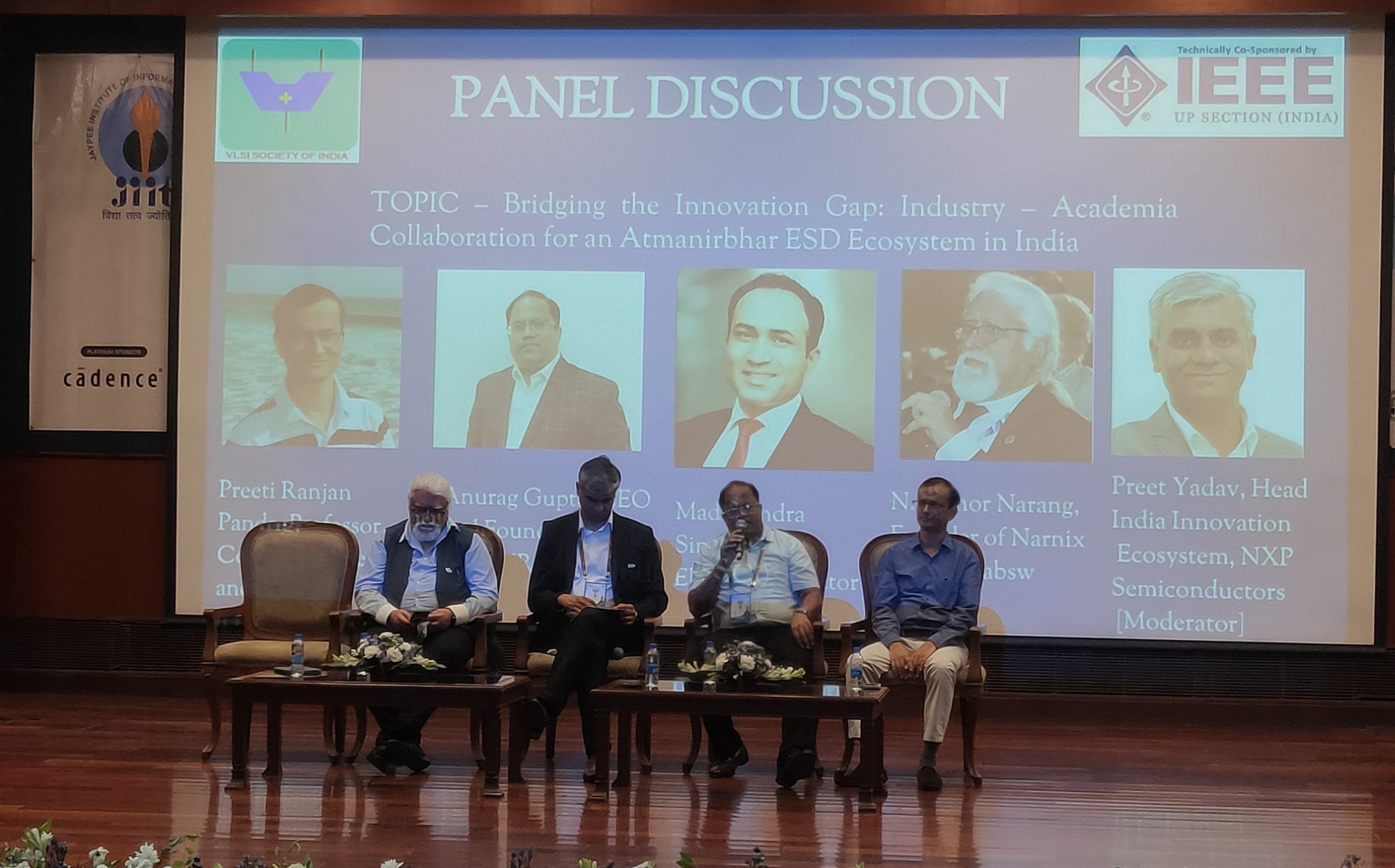
30th International Symposium on VLSI Design and Test (VDAT 2026) Inaugurated at JIIT Noida
The 30th International Symposium on VLSI Design and Test (VDAT 2026) was inaugurated today at Jaypee Institute of Information Technology (HIT), Noida, bringing together eminent academicians, semiconductor industry leaders, researchers, policymakers and students to deliberate on emerging technologies shaping the future of semiconductor and intelligent computing systems. The three-day symposium is being held from 20-22 August 2026 with the theme “Advancing Intelligent, Secure and Quantum-Ready Semiconductor Systems for the Next Era of Computing.”
The landmark edition is being hosted by JIIT in collaboration with Delhi Technological University (DTU), Indraprastha Institute of Information Technology Delhi (HIT-Delhi), Indira Gandhi Delhi Technical University for Women (IGDTUW), National Institute of Technology Delhi (NIT Delhi) and Netaji Subhas University of Technology (NSUT), with the support of the VLSI Society of India (VSI) and IEEE Uttar Pradesh Section. VDAT has been a flagship platform of VSI for three decades, connecting researchers, academia and industry in VLSI design, semiconductor technologies, testing, EDA, embedded systems and emerging computing technologies.
Bringing The Industry and Academia TogetherThe 30th edition is particularly significant as VDAT is being organized in Uttar Pradesh for the first time in its history. Its presence in Noida reflects the growing importance of the Noida—Greater Noida region in India’s electronics, semiconductor, data-centre and advanced-manufacturing landscape, while providing a platform to connect the state’s emerging priorities in electronics manufacturing, semiconductor investment, innovation and high-technology employment with leading researchers and industry.
The inaugural ceremony was graced by Ms. Sunita Verma, Scientist-G and Group Coordinator, R&D Dix4sion, Ministry of Electronics and Information Technology (MeitY), Government of India, as the Chief Guest, and Dr. Kamaljeet Singh, Director General, Semi-Conductor Laboratory (SCL), Mohali, as the Guest of Honour. The ceremony also witnessed the presence of Prof. S. C. Saxena, Pro-Chancellor, HIT; Prof. Shweta Srix’astava, Director, HIT and General Chair, VDAT 2026; Dr. Satya Gupta, President, VLSI Society of India; Chitra Hariharan, Secretary, VLSI Society of India; Prof. Prateek Sharma, Vice Chancellor, DTU; and Prof. Ranjana Jha, Vice-Chancellor, IGDTUW, among other distinguished guests.
In her address, Ms. Sunita Verma emphasised the strategic importance of India’s semiconductor journey and the need to strengthen capabilities across chip design, fabrication, advanced packaging, testing, materials, equipment and intellectual property. She highlighted the growing significance of Al, edge computing, hardware security, heterogeneous integration, chiplets, silicon photonics and quantum technologies, and stressed collaboration among government, academia, industry, start ups and research institutions.
Dr. Kamaljeet Singh emphasised the strategic importance of strengthening India’s indigenous semiconductor capabilities and developing a robust ecosystem spanning research, design, fabrication and technology deployment. He highlighted stronger academia—industry—government collaboration an essential to accelerating semiconductor innovation and supporting India’s strategic and emerging technology requirements.
Dr. Satya Gupta, President, VLSI Society of India, highlighted that continued evolution of VDAT us a platform for leading researchers, industry experts and students to exchange innovations in VLSI design, semiconductor technologies, testing and system design, 8iid emphasised the relevance of the 2G26 theme to AI, sect hardware, heterogeneous integration and quantum computing.
Decoding the Intricacies of The Electronics UniverseThe inaugural programme featured addresses by Prof. S. C. Saxena, Dr. Satya’ Gupta and Chitra Hariharan, Dr. Kamaljeet Singh, Ms. Sunita Verma and Mr. Hitesh Garg, Vice President and India Managing Director, NXP Semiconductors. It also featured the Synopsys—JIIT Tapeout Initiative, presented by Mr. Amit Khanuja, VP—RD Engineering, IP Group, Synopsys, the unveiling of the VDAT 2026 Proceedings, and inauguration of the Cadence-Certified Laboratory by Ms. Tal Zigman, Global Academic Network, Cadence Design Systems.
The symposium received 441 research papers from 78 institutions, of which 122 papers were accepted, representing an acceptance rate of 27.7%. The research programme covers seven technical tracks addressing contemporary areas of VLSI and semiconductor technology, including circuits and SoC design, embedded systems, AI hardware and design automation, emerging semiconductor devices, advanced integration, hardware security, advanced memory architectures and quantum ready technologies.
The three-day programme also includes keynote addresses, invited talks, tutorials, a PhD Forum, Startup/Chippreneur activities, poster sessions and industry—academia interactions, providing opportunities for researchers and young technology professionals to engage with experts from leading organisations including NXP Semiconductors, Cadence, Synopsys, STMicroelectronics and Renesas.
The symposium marks an important milestone for HIT Noida and the Delhi-NCR academic consortium, providing a platform to showcase the region’s academic and technological capabilities and strengthen connections with India’s growing semiconductor and electronics ecosystem. The organisers expressed their appreciation to the distinguished speakers, participating institutions, industry partners, researchers, reviewers, students and volunteers for their contribution to the successful organisation of VDAT 2026.
The post 30th International Symposium on VLSI Design and Test (VDAT 2026) Inaugurated at JIIT Noida appeared first on ELE Times.
EPC announces mass production of EPC2370 18V GaN FET for next-gen AI power architectures
Op-amp input filtering can cause instability without proper compensation

When applying an input signal to an operational amplifier (op amp) that is far beyond its bandwidth, you would expect that the op amp would reject or attenuate the input signal. For example, if you’re applying a 600-MHz input signal to an op amp with a 10-MHz bandwidth, you would expect the 600-MHz signal to have significant attenuation. Both SPICE and general amplifier theory will predict this expected output.
Unfortunately, the high-frequency noise will not be rejected, and will actually cause a shift in the op amp’s input offset voltage (VOS). In addition to the shift in offset, some of the high-frequency noise will simply pass through the op amp.
Some op amps are better at rejecting this high-frequency signal than others: The ability of an op amp to reject radio-frequency signals is called the electromagnetic interference rejection ratio (EMIRR). See the application report, “EMI Rejection Ratio of Operational Amplifiers” with OPA333 and OPA333-Q1 op amps as a design example.
Amplifiers with good EMIRR often have a simple internal filter on the input pins of the op amp. Amplifiers with this feature are called EMI-hardened. The input filter is a simple RC filter where the amplifier inputs have small resistors and capacitors placed both in common mode and differentially across the inputs (Figure 1). The input resistors generate noise, and the differential capacitor can degrade amplifier stability, so there are limits to how effective this filter can be.

Figure 1 Here is how EMI-hardened op-amp works using input filtering. Source: Texas Instruments
To improve the EMI rejection, many engineers choose to add an external filter capacitor across the input pins of the op amp. This can be an effective solution, but the op amp generally needs additional components to maintain stability. Stability in this context is the ability of an op amp to properly amplify a signal without oscillating.
Op amps can become unstable when connecting a capacitive load to the output pin or when capacitance connects to the inverting node. For the EMI filter, the concern is the capacitance on the inverting node because the filter capacitor is connected between the inverting and noninverting nodes.
It’s possible to use a transient small-signal step on the input or a transient load step on the output of an op amp to test stability. The amount of overshoot to the step directly relates to the circuit phase margin, which is a measurement of stability. A circuit is considered to be stable with an overshoot of less than 23%, which corresponds to a phase margin of greater than 45 degrees.
For a circuit with a filter on the input pins, test the stability with an output load step rather than an input step. An input step does not work for this circuit because the edges on the input step will be filtered by differential capacitance.
Figure 2 shows the transient response stability test for the uncompensated amplifier to a ±1 mA load step. The circuit in this example is a difference amplifier with a 1-nF filter capacitance between the inputs. For the load-step stability test, the initial output transient spike is the step size, and the following spike is the overshoot.

Figure 2 A transient output load stability test shows instability. Source: Texas Instruments
The percentage overshoot for Figure 2 is 68.2% (see Equation 1):

The Analog Engineer’s Calculator can convert the percentage overshoot to a phase margin of 13.8 degrees (Figure 3). The circuit is unstable, since a phase margin of greater than 45 degrees is required for stability.

Figure 3 Analog Engineer’s Calculator is used to convert overshoot to phase margin. Source: Texas Instruments
Understanding why the input capacitor causes instability requires some background in stability theory. Figure 4 shows the standard open-loop test circuit applied to the same circuit that underwent the transient stability test.

Figure 4 Here is a view of open-loop test circuit for op-amp stability. Source: Texas Instruments
The open loop is the most accurate way to test stability; it provides curves for open-loop gain (AOL), loop gain (AOL×β), 1/β, and phase margin (Figure 5). Stability is tested at the point where 1/β intersects AOL. The phase margin is the phase shift where AOL intersects 1/β.

Figure 5 Open-loop stability results show instability. Source: Texas Instruments
The phase margin for the open-loop circuit is 17.5 degrees, whereas the phase margin from the transient step test was 13.8 degrees. Technically the two numbers should match exactly, but there are some differences because the transient test assumes that the system is a second-order system. Nevertheless, the results are reasonably close, and both results indicate instability.
The open-loop test has an additional benefit in that it provides insight into what is causing the stability problem and how to stabilize the circuit. One way to understand the source of the stability issue is to use the rate-of-closure (ROC) rules. The ROC looks at the difference in slopes where the AOL and 1/β curve intersect.
If the difference in slopes is greater than 40 dB/decade, then the circuit is unstable. In Figure 5, the slope of AOL is –20 dB/decade, and the slope of 1/β is +20dB/decade. The difference between these two slopes is 40 dB/decade, so the circuit is unstable (Equation 2):

To correct the stability issue, you need to adjust the ROC to 20 dB/decade. The problem in this example is that 1/β has a zero at approximately 87.5 kHz, which causes the gain to increase by 20 dB/decade (Equation 3):

Adding a pole at the same frequency cancels this zero. The zero frequency is set by CIN and 2 × RG, and CF and RF set the pole frequency. To set the pole frequency the same as the zero frequency, choose CF so that RF × CF = RIN × CIN. In this example, setting CF = 100 pF will cancel the zero (Equation 4):

Setting CF = 200 pF yields the open-loop response shown in Figure 6. Note that the 1/β curve is completely flat because the pole and zero cancel each other (Equation 5 and Equation 6). Since the ROC is now 20 dB/decade and the phase margin is 81 degrees, the circuit is stable.

Figure 6 Stable open-loop response is shown with CF = 100 pF. Source: Texas Instruments
The compensated transient response, shown in Figure 7, also shows minimal overshoot and no ringing, indicating good stability.

Figure 7 Stable transient response is shown with CF = 200 pF. Source: Texas Instruments
Setting the pole and zero in 1/β equal provides good stability and also improves noise, since the noise-gain peaking is minimized. It’s possible to stabilize the circuit and increase the bandwidth using a smaller value of CF, however. Equation 7 gives the minimum value of CF that will stabilize the circuit, and Equation 8 applies the example values.


Figure 8 shows the open-loop and transient response for the minimum CF value (CF_MIN = 47pF). The phase margin is lower for the minimum value of CF compared to the case where the pole and zero cancel, but the circuit is still very stable (phase margin = 62 degrees).

Figure 8 Open-loop and transient response is shown for minimum CF compensation. Source: Texas Instruments
Figure 9 compares the bandwidth and noise for the two compensation options.

Figure 9 Here is a comparison between bandwidth and noise for two different CF compensations. Source: Texas Instruments
Stabilize the circuit
When using a capacitive filter across the input pins of an op amp, it’s important to use feedback capacitors to stabilize the circuit. The theory presented in this article is useful for understanding the root cause, but not necessary to compensate the circuit. Ultimately, you can stabilize the circuit by choosing the feedback capacitors according to Equation 3.
The feedback capacitor can also be helpful in reducing noise and stabilizing circuits with capacitive load. In general, it’s a good idea to include a placeholder for the feedback capacitors in most op-amp circuits because it can often be helpful in resolving stability and noise issues.
 Art Kay is application engineer at Texas Instruments.
Related Content
- The perils of input capacitance
- Active filters: Design tips and tricks
- Tips and Techniques for Capacitor Testing
- Designing RC active filters with standard-component values
- Testing op amp tools for their active filter design accuracy and dynamic range
The post Op-amp input filtering can cause instability without proper compensation appeared first on EDN.
Power GaN device market growing at 35% CAGR to $3.5bn in 2031, driven by data centers, EVs and industrial systems
Debugging intermittent Comcast, part 1: Scenario-setting

Inconsistency is a fundamental bane of troubleshooting. So it goes at work…and also at home.
At some point(s) in your engineering career, have you ever had the “pleasure” of inheriting the ongoing development and maintenance for a poorly-at-best documented project whose original leader was no longer available for advisement? Me too; I’ve dealt with handoff aftereffects for more than a dozen years so far with no definitive end in sight, albeit with increasing clarity as time passes. But in the case study described today, my project is personal, not professional.
When my then-fiancée (now-wife) and I bought the home we now live in, the previous owner had recently passed away and the original builders/owners were also no longer available for consultation (the husband is also deceased, I believe; I don’t have any contact-or-other info about his wife). So, aside from a pile of user manuals, receipts and other paperwork, I was pretty much on my own in sorting out the plumbing, mechanical, electrical, and other aspects of the residence.
An incomplete historyJudging from reputation per conversations with neighbors, not to mention the thick speaker wiring still installed in various rooms’ walls and baseboards, along with a nice set of B&W outdoor speakers, the prior owner was an enthusiastic audiophile. And judging from the sizeable living room plasma television, not to mention the projection system downstairs, also a videophile (as well as, I suspect, a “techie”).
So, it was no surprise to be told by the realtor that the home was already pre-wired for Comcast (a.k.a. Xfinity, the company’s brand for consumer products and services) broadband and television. That said, the only residence-specific detail I was aware of, and mentioned by the realtor only in passing, was that the prior owner “had another line of service installed” at some point. Hold that though.
When I moved in, I transferred my existing Comcast service from my previous Colorado residence, a process that to the best of my recollection was quick and painless. Coax cable runs on top of (plus shallowly under) the ground, as well as being attached to exterior walls at three of the four sides of the home, along with shielded, outdoor-rated Ethernet cable (all of which I’ve mentioned before).
The technician showed me which coax feed I should plug my cable modem into. And with that, for the next decade-plus and beyond relocating that strand’s interior end to my furnace room, which became the home’s networking nexus, and upgrading my service tier during the COVID-19 pandemic, ignorance was bliss.
I’ve played around a bit with MoCA in attempting to wired-extend the LAN to two guest bedrooms downstairs, versus running new Ethernet feeds or just relying on Wi-Fi. Beyond that, I kept the various wall-mounted coax connectors scattered around the house capped with terminators, since I was instead leveraging Windows Media Center over Ethernet to distribute TV service from a networked CableCard triple-tuner device and a Windows 7-based PC to various Xbox 360-based clients.

Eventually, I expanded from a single-router setup to a multi-node mesh network, still using wired Ethernet for the backbone. All this time, the mysterious plastic box labeled “Comcast” in one corner of the property nagged at me.

As did the realtor’s cryptic “prior owner had another line of service installed” insight. But in the spirit of “if it works, don’t touch it,” I held my curiosity at bay…until last October, when necessity first forced my hand. In preparation for the nearby emergency access road construction that began shortly thereafter, the community’s water and sanitation service upgraded my neighborhood’s hydrants, so they could alternatively act as conveniently-located refill sites for water trucks. Unfortunately, in the process of replacing the hydrant across the street from me, they inadvertently also cut the thick coax feed(s) that Comcast-serviced my residence as well as that of my next-door neighbor.
After alerting Comcast to the fact that I was having a problem that was theirs, not mine, to solve (I can’t count the number of times I’ve heard the words “when’s the last time you replaced your cable modem” in the last near-year), they sent out a diagnostics tech, who confirmed the cut.


The community’s water and sanitation service washed their hands of the issue, since it turns out Comcast had seemingly neglected to add the wiring to publicly accessible maps post-initial installation. And it took another couple of days to get a different Comcast technician out to spend nearly a day digging up the wiring, re-splicing it back together, and re-burying it.


Broadband and television service came back up immediately…but only for about 24 hours; then they went down again, this time only for a couple of hours (that day, at least). I’d never experienced Comcast flakiness before, so it wasn’t much of stretch to associate not only a correlation but a more definitive causation between what I was now experiencing and the day-prior repair attempt.
I’d already realized that a simple cable splice, versus a comprehensive full-run replacement, would result in at least a modicum of SNR loss. I deduced the incremental signal degradation had “pushed” our apparently already-marginal service “over a cliff”, at least periodically.
What symptoms did I notice whenever I was having Comcast service issues, aside from the fact that LAN devices would lose Internet connectivity and sometimes the router itself would also go down (since the Google Nest system is cloud-managed)? The second LED from the top of my Netgear CM1100 cable modem, referencing downstream connectivity, would perpetually blink, with those below it non-illuminated.
And speaking of the cable modem, sometimes even when I was online, the third LED down, referencing upstream connectivity, would still blink (versus its usual steady-illuminated state). That all said, unless broadband connectivity went down for an extended period, and sometimes even if it did, television service often still remained “up”.

Convincing Comcast of the validity of my ongoing issues—not to mention the company’s ongoing responsibility for solving them—was a different matter. The first tech that came out had given me his business card with an invitation to reach out if I continued having issues. Every time I texted him—I did strive to practice at least some restraint—he’d remote-check my modem and CableCard status and report back no issues logged on his end, including no T2, T3 or T4 timeouts.
There was also seasonal variability to the unreliability (assumed associations: ambient temperature and moisture). As autumn turned to winter, the outages thankfully became less frequent, at least for a while (again, hold that thought). So, I eventually gave up trying to get someone back out on Comcast’s dime and switched over to cellular hotspots whenever broadband started flaking out.
Learnings and lingering mysteries from this portion of the story:
- The Comcast “tap” that services me and my next-door neighbor, it turns out, is at the very end of the line that runs through our neighborhood. Service-drop alerts sent to Comcast when customers’ cable modems, set-top boxes, and the like go offline only automatically result in a “truck roll” when a critical mass of customers are simultaneously affected. I don’t remember the exact number, but I think the tech said a half-dozen or thereabouts. Otherwise, Comcast logs the situation as a potential issue (similar to what happens if a customer reports an outage over the phone or in-app) but by default assumes a power outage or other unrelated-to-Comcast problem is the root cause of the service glitch. This is why I had to work so hard on my end to get the repair going in the first place.

- You might have noticed in the earlier photos I took last fall that there are two thick coax feeds that had gotten severed. Particularly given that ours was the last line “tap”, I was baffled as to why there wasn’t just one cut cable. Descriptions sometimes refer to such lines as “loops” or “rings”, which initially explanation-contented me. But I more recently came up with what I think is a more likely answer. Again, hold that thought.
Fast-forward to June of this year. We were still getting occasional outages, but only a couple of times a month, most of them lasting only a few minutes each, and typically happening in the mid- to late-afternoons (again, with an assumed ambient temperature association). But one day, broadband was up-and-down (lather, rinse and repeat) for several hours straight. I decided to take a break from work and go for a hike around the neighborhood, wherein I came across a bunch of Comcast trucks.

Apparently, an Xcel Energy boring machine digging a pathway under the road in preparation for running electrical cabling had once again sliced through a Comcast feed, this one servicing an entire street’s worth of customers next to ours. And although we didn’t solidly lose service where I lived, the technician I spoke with indicated that as part of the repair, they were re-tuning all the area’s line RF amplifiers, thereby explaining why our service was also up-and-down for so long that afternoon. Here’s what a few of the neighborhood RF amps look like:


Including this one near the cut location, which for some reason, ended up with its top still off (or is this a broader area-servicing fiber coax transceiver node, readers? Let me know in the comments!


And then there’s this unidentified (again, readers?) hunk of equipment right next to it, also surrounded by Comcast “flags”, in this case with its cover still intact albeit ajar.

Unfortunately, this re-tuning apparently further suppressed the ongoing SNR at my residence, because beginning the very next day I started experiencing more frequent outages again, this time roughly every other day. I eventually rang up Comcast again and scheduled a technician call for the next day. That evening, when service came back, Comcast called me back and tried its best to convince me to cancel my appointment, but I strongly declined the offer.
I’ll continue the story in part 2 of this series, scheduled for publication next week. Until then, I as-always welcome your thoughts in the comments!
—Brian Dipert is the associate editor, as well as a contributing editor, at EDN.
Related Content
- Dear Comcast, we haven’t yet tangled our last
- Keeping technology user-friendly and simple: the latest failure example
- Will a location change improve my MoCA?
- The whole-house LAN: Achilles-heel alternatives, tradeoffs, and plans
- A quest for faster upstream bandwidth
- Debugging a “buggy” networked CableCARD receiver
The post Debugging intermittent Comcast, part 1: Scenario-setting appeared first on EDN.
Palo Alto Networks Introduces Frontier AI Critical Defense Program
Palo Alto Networks today announced the Frontier AI Critical Defense Program, a first-of-its-kind initiative to protect critical infrastructure from AI-driven exploits. Through the program, leaders across operational technology (OT), healthcare, commercial software and open-source communities coordinate with Palo Alto Networks to deploy proactive & “virtual patches,” neutralizing vulnerabilities at the network-level before attackers can exploit them.
Palo Alto Networks recently used Frontier AI models to uncover more than 14,000 previously unknown vulnerabilities in open source software, underscoring how AI could enable threat actors to automate cyberattacks and shrink attack timelines. Yet, critical infrastructure operators, constrained by strict uptime and safety testing, cannot patch at AI speed. This mismatch creates a significant exposure gap, leaving essential systems vulnerable long before software fixes can be safely deployed.
True defense at AI speed requires joint action. This program builds on our existing collaborations with IBM and Red Hat (as part of Lightwell), Microsoft (as part of MAPP) and OT leaders like Siemens and the Idaho National Laboratory (as part of the OT Threat Research Lab).
Today, the collaboration is expanding to include Anthropic, OpenAI, OT leaders like Mitsubishi and Axis Communications, industry consortiums for sharing risk information like Analysis and Resilience Center for Systemic Risk and Health-ISAC, OT research organizations like the independent, non-profit Energy R&D Institute (EPRI) and OSS initiatives like Akrites (an initiative from the Linux Foundation).
Palo Alto Networks Frontier Virtual Patching puts these insights into action to deliver proactive protection for joint customers. By combining Frontier AI threat discovery with trusted vulnerability intelligence, it delivers rapid network-level patches while safeguarding sensitive vulnerability details from attackers.
Lee Klarich, Chief Product Officer, Palo Alto Networks
“In the age of Frontier AI, the traditional, reactive race to build and deploy software patches before adversaries exploit a flaw is a losing battle. Protecting critical infrastructure requires a structural shift from isolated patching to collective, proactive intelligence. Through initiatives like our Frontier AI Critical Defense Program, we can neutralize threats at the network layer before they are weaponized.”
Help safeguard critical infrastructure by joining the expanding Frontier AI Critical Defense Program, today. Visit the website to learn more on how to get involved, or explore Palo Alto Networks broader Frontier AI Defense Initiative.
The post Palo Alto Networks Introduces Frontier AI Critical Defense Program appeared first on ELE Times.
Micross acquiring AEMtec, expanding reach into Europe
GaN epilayers grown on TekSiC’s semi-insulating silicon carbide wafers
Лабораторії 4.0: кафедра електропостачання модернізує навчальний простір

Поки студенти відпочивають на канікулах, а викладачі набираються сил перед новим навчальним роком, на кафедрі електропостачання КПІ ім. Ігоря Сікорського триває активна робота. Для кафедри літо — це не перерва, а час оновлення та розвитку лабораторної бази.
📯 Порядок постановки на військовий облік студентів та аспірантів ПЕРШОГО курсу 2026 року набору

🔸 Шановні вступники чоловічої статі! Повідомляємо, що всі громадяни України чоловічої статі 2009 року народження і старші, обов’язково повинні мати військово-обліковий документ (ВОД) сформований з використанням мобільного додатка Порталу Дія (Резерв+).
ROHM to Showcase Application-Focused Power and Analog Solutions at electronica India 2026
ROHM will exhibit at electronica India 2026, South Asia’s leading trade fair for electronic components, systems, applications, and solutions, from September 16th to 18th at the Bangalore International Exhibition Centre (BIEC). At booth I-15 in Hall 3, ROHM will showcase application-focused demonstrations featuring its semiconductor devices and reference designs for mobility and industrial applications.
“Electronica India 2026 will be an important opportunity to demonstrate how ROHM’s power and analog semiconductor technologies contribute to real-world applications across mobility and industrial systems. This year, we will present more application-oriented demonstrations, including a three-wheeled concept vehicle that shows how ROHM semiconductor devices and reference designs can be integrated into mobility systems, as well as reference-design boards for AI server power supplies. Through these exhibits, we aim to foster more application-driven technical discussions with customers and partners in India and support them as they address challenges related to power conversion, energy efficiency, and system design,” says Makoto Terada, Managing Director, ROHM Semiconductor India.
Highlights of ROHM’s presence at electronica India 2026 include:
For Mobility
- The three-wheeled EV concept vehicle demonstrating how ROHM semiconductor devices and
reference designs can be applied to mobility systems, including motor control, smart instrument
cluster, and lighting solutions - Engine control ICs and LED driver ICs for Two-wheeled vehicles
- Sonar demonstrations for automotive applications
For Industrial
- 1.3 kW and 5.5 kW reference designs for AI server power supplies
- Reference designs for power conversion in EV chargers and PV inverters
- Sub-GHz wireless communication LSIs and chiplet-based MCUs
- Use cases for Solist-AI, ROHM’s edge computing AI solution
The post ROHM to Showcase Application-Focused Power and Analog Solutions at electronica India 2026 appeared first on ELE Times.
UiPath Introduces UiPath Maestro Flow, Delivering Developer-First Orchestration for Coding Agents
UiPath, Inc., a global leader in business orchestration and automation, today announced UiPath Maestro Flow, a developer-first orchestration canvas combining the speed of modern, AI-native development with enterprise-grade durability and governance. Using Maestro Flow, builders can use supported coding agents to design, run, observe, and govern an end-to-end process as a single artifact, from prototype to production.
With the popularity of coding agents, enterprise builders can build AI agents quickly, but struggle to implement and run them as real business processes across systems. Without a critical layer of orchestration, process logic becomes fragmented, difficult to govern, and costly to maintain—prototypes cannot ship, work stalls while waiting on review, automations are not tracked, and the cost of experimentation itself becomes a brake on progress.
Maestro Flow closes that gap. Builders can use the coding agents they already rely on—including Claude Code, Cursor, GitHub Copilot, and Codex—to design, run, observe, and govern complete business processes as a single artifact, all from their native development environment, such as VS Code or UiPath Studio. It is a fast, code-first build experience directly on an enterprise grade orchestration engine, so the version prototyped is the version that ships into production, without rebuilding or re platforming.
Maestro Flow enables teams to build at prototype speed and run with production durability. Teams keep the code-first workflow they already use, while enterprises gain the execution, observability, and governance needed for production. Coordinating AI agents, robots, APIs, documents, and people within one flow, Maestro Flow runs on the same Maestro orchestration engine enterprises already trust.
“Enterprises don’t have an agent problem; they have an orchestration problem,” said Raghu Malpani, Chief Product and Technology Officer, UiPath. “With coding agents, it’s never been easier to build an agent. But running a real business process, spanning agents, robots, systems, and people—and being able to prove what happened at every step—needs an orchestration layer that ties these together in a real business environment. Maestro Flow is that missing layer, and it runs on the durable, governed orchestration foundation in the UiPath Platform that our customers already trust.”
Developers can get started today with UiPath Maestro Flow by clicking the “Try Now” button at www.uipath.com/product/maestro/flow. For those developers interested in trying out UiPath Maestro, UiPath is offering UiPath Maestro Lite, a lightweight option for processes that do not require extensive management, matching operational depth with the cost and criticality of the work.
The post UiPath Introduces UiPath Maestro Flow, Delivering Developer-First Orchestration for Coding Agents appeared first on ELE Times.
EEVblog 1767 - Harogic PXN-90 9GHz Spectrum Analyser TEARDOWN
Smart modules bring Android 16 to IoT designs

Quectel’s 4G SH602FA and 5G SE505FE smart modules feature built-in Android 16 to accelerate industrial and commercial IoT development. The modules enable developers to build connected products such as handheld terminals and inspection devices with rich user interfaces and enhanced multimedia performance.

The 4G SH602FA is powered by a MediaTek MT8786 chipset with a 64-bit octa-core processor comprising two Arm Cortex-A75 cores and six Cortex-A55 cores. An Arm Mali-G52 MC2 GPU supports graphics-intensive embedded applications without requiring an external host processor. The smart module integrates LTE Cat 4, Wi-Fi 802.11ac, Bluetooth 5.1, and GNSS, along with camera and touch-panel interfaces.
Offering Android 16-powered 5G connectivity, the SE505FE leverages a MediaTek MT8863T chipset with a 64-bit octa-core processor comprising two Arm Cortex-A76 cores and six Cortex-A55 cores, along with an Arm Mali-G57 GPU. The module supports 5G sub-6-GHz and LTE Cat 4, together with Wi-Fi 6, Bluetooth 5.2, and GNSS.
A timeline for module availability was not provided at the time of this announcement.
The post Smart modules bring Android 16 to IoT designs appeared first on EDN.
Class-D amplifier enhances automotive audio performance

A Class-D mono audio amplifier, the PAM2011Q from Diodes delivers up to 3 W of output power for automotive applications. Designed for instrument clusters, dashboard and backup cameras, driver notification chimes and warnings, and emergency call (eCall/T-box) systems, the filter-free amplifier provides 1.8-mA quiescent current and up to 94% efficiency.

The PAM2011Q comes in a compact, thermally enhanced package and requires minimal external components, simplifying design and reducing system cost. It operates from a 2.8-V to 6.0-V supply and delivers 2.53 W at 1% THD and 3.15 W at 10% THD from a 5-V supply into a 4-Ω load. Audio specifications include THD+N below 0.03% and 21-µV integrated output noise (A-weighted) at 6-dB gain.
The amplifier is AEC-Q100 qualified and operates over a junction temperature range of -40°C to +125°C. Integrated de-pop circuitry provides silent startup and shutdown while eliminating unwanted noise. Overvoltage and overtemperature protection with auto-recovery are also integrated to enhance system reliability.
The PAM2011Q is available now from Mouser Electronics.
The post Class-D amplifier enhances automotive audio performance appeared first on EDN.
Pages