


Feed aggregator
ROHM to Showcase Application-Focused Power and Analog Solutions at electronica India 2026
ROHM will exhibit at electronica India 2026, South Asia’s leading trade fair for electronic components, systems, applications, and solutions, from September 16th to 18th at the Bangalore International Exhibition Centre (BIEC). At booth I-15 in Hall 3, ROHM will showcase application-focused demonstrations featuring its semiconductor devices and reference designs for mobility and industrial applications.
“Electronica India 2026 will be an important opportunity to demonstrate how ROHM’s power and analog semiconductor technologies contribute to real-world applications across mobility and industrial systems. This year, we will present more application-oriented demonstrations, including a three-wheeled concept vehicle that shows how ROHM semiconductor devices and reference designs can be integrated into mobility systems, as well as reference-design boards for AI server power supplies. Through these exhibits, we aim to foster more application-driven technical discussions with customers and partners in India and support them as they address challenges related to power conversion, energy efficiency, and system design,” says Makoto Terada, Managing Director, ROHM Semiconductor India.
Highlights of ROHM’s presence at electronica India 2026 include:
For Mobility
- The three-wheeled EV concept vehicle demonstrating how ROHM semiconductor devices and
reference designs can be applied to mobility systems, including motor control, smart instrument
cluster, and lighting solutions - Engine control ICs and LED driver ICs for Two-wheeled vehicles
- Sonar demonstrations for automotive applications
For Industrial
- 1.3 kW and 5.5 kW reference designs for AI server power supplies
- Reference designs for power conversion in EV chargers and PV inverters
- Sub-GHz wireless communication LSIs and chiplet-based MCUs
- Use cases for Solist-AI, ROHM’s edge computing AI solution
The post ROHM to Showcase Application-Focused Power and Analog Solutions at electronica India 2026 appeared first on ELE Times.
UiPath Introduces UiPath Maestro Flow, Delivering Developer-First Orchestration for Coding Agents
UiPath, Inc., a global leader in business orchestration and automation, today announced UiPath Maestro Flow, a developer-first orchestration canvas combining the speed of modern, AI-native development with enterprise-grade durability and governance. Using Maestro Flow, builders can use supported coding agents to design, run, observe, and govern an end-to-end process as a single artifact, from prototype to production.
With the popularity of coding agents, enterprise builders can build AI agents quickly, but struggle to implement and run them as real business processes across systems. Without a critical layer of orchestration, process logic becomes fragmented, difficult to govern, and costly to maintain—prototypes cannot ship, work stalls while waiting on review, automations are not tracked, and the cost of experimentation itself becomes a brake on progress.
Maestro Flow closes that gap. Builders can use the coding agents they already rely on—including Claude Code, Cursor, GitHub Copilot, and Codex—to design, run, observe, and govern complete business processes as a single artifact, all from their native development environment, such as VS Code or UiPath Studio. It is a fast, code-first build experience directly on an enterprise grade orchestration engine, so the version prototyped is the version that ships into production, without rebuilding or re platforming.
Maestro Flow enables teams to build at prototype speed and run with production durability. Teams keep the code-first workflow they already use, while enterprises gain the execution, observability, and governance needed for production. Coordinating AI agents, robots, APIs, documents, and people within one flow, Maestro Flow runs on the same Maestro orchestration engine enterprises already trust.
“Enterprises don’t have an agent problem; they have an orchestration problem,” said Raghu Malpani, Chief Product and Technology Officer, UiPath. “With coding agents, it’s never been easier to build an agent. But running a real business process, spanning agents, robots, systems, and people—and being able to prove what happened at every step—needs an orchestration layer that ties these together in a real business environment. Maestro Flow is that missing layer, and it runs on the durable, governed orchestration foundation in the UiPath Platform that our customers already trust.”
Developers can get started today with UiPath Maestro Flow by clicking the “Try Now” button at www.uipath.com/product/maestro/flow. For those developers interested in trying out UiPath Maestro, UiPath is offering UiPath Maestro Lite, a lightweight option for processes that do not require extensive management, matching operational depth with the cost and criticality of the work.
The post UiPath Introduces UiPath Maestro Flow, Delivering Developer-First Orchestration for Coding Agents appeared first on ELE Times.
EEVblog 1767 - Harogic PXN-90 9GHz Spectrum Analyser TEARDOWN
Smart modules bring Android 16 to IoT designs

Quectel’s 4G SH602FA and 5G SE505FE smart modules feature built-in Android 16 to accelerate industrial and commercial IoT development. The modules enable developers to build connected products such as handheld terminals and inspection devices with rich user interfaces and enhanced multimedia performance.

The 4G SH602FA is powered by a MediaTek MT8786 chipset with a 64-bit octa-core processor comprising two Arm Cortex-A75 cores and six Cortex-A55 cores. An Arm Mali-G52 MC2 GPU supports graphics-intensive embedded applications without requiring an external host processor. The smart module integrates LTE Cat 4, Wi-Fi 802.11ac, Bluetooth 5.1, and GNSS, along with camera and touch-panel interfaces.
Offering Android 16-powered 5G connectivity, the SE505FE leverages a MediaTek MT8863T chipset with a 64-bit octa-core processor comprising two Arm Cortex-A76 cores and six Cortex-A55 cores, along with an Arm Mali-G57 GPU. The module supports 5G sub-6-GHz and LTE Cat 4, together with Wi-Fi 6, Bluetooth 5.2, and GNSS.
A timeline for module availability was not provided at the time of this announcement.
The post Smart modules bring Android 16 to IoT designs appeared first on EDN.
Class-D amplifier enhances automotive audio performance

A Class-D mono audio amplifier, the PAM2011Q from Diodes delivers up to 3 W of output power for automotive applications. Designed for instrument clusters, dashboard and backup cameras, driver notification chimes and warnings, and emergency call (eCall/T-box) systems, the filter-free amplifier provides 1.8-mA quiescent current and up to 94% efficiency.

The PAM2011Q comes in a compact, thermally enhanced package and requires minimal external components, simplifying design and reducing system cost. It operates from a 2.8-V to 6.0-V supply and delivers 2.53 W at 1% THD and 3.15 W at 10% THD from a 5-V supply into a 4-Ω load. Audio specifications include THD+N below 0.03% and 21-µV integrated output noise (A-weighted) at 6-dB gain.
The amplifier is AEC-Q100 qualified and operates over a junction temperature range of -40°C to +125°C. Integrated de-pop circuitry provides silent startup and shutdown while eliminating unwanted noise. Overvoltage and overtemperature protection with auto-recovery are also integrated to enhance system reliability.
The PAM2011Q is available now from Mouser Electronics.
The post Class-D amplifier enhances automotive audio performance appeared first on EDN.
Channel emulator adds 6G, Wi-Fi 7/8 testing

The Vertex 6.0 channel emulation platform from VIAVI supports carrier frequencies up to 23.6 GHz and 400 MHz of instantaneous bandwidth. The company says it is the industry’s first channel emulator for 6G and Wi-Fi 7/8 testing, meeting newly defined 6G waveform requirements and exceeding Wi-Fi 7/8 bandwidth requirements. The enhanced platform features field-replaceable RF modules that can be installed in an existing 6U Vertex chassis.

Building on the 5G FR1/FR2 capabilities of the previous generation, Vertex 6.0 recreates real-world wireless conditions in the lab for complex cellular, Wi-Fi, military, and aerospace RF applications. Combined with the VIAVI FR3 MIMO converter and raytracing, the platform serves as a digital twin for RF propagation, enabling use cases such as FR3, Wi-Fi 7, AI-RAN, and ISAC.
Each chassis accommodates 36 RF ports, 256 digital links, and up to 1.6 GHz of bandwidth. For cellular technologies, the platform handles FR3 bands with up to 1 GHz of bandwidth. For Wi-Fi 7/8, it offers native support for 320 MHz and 4096 QAM in 2×2 to 8×8 configurations. The channel emulator supports land-to-land, land-to-air, and air-to-air transmissions, including anechoic and reverberation OTA chambers, NTN (LEO, MEO, and GEO), mesh, drone, and ISAC networks.
The post Channel emulator adds 6G, Wi-Fi 7/8 testing appeared first on EDN.
Load switch guards automotive power rails

Kinetic Technologies’ KTS1642Q AEC-Q100-qualified load switch protects automotive loads from abnormal power-supply or load conditions. When used with the appropriate external TVS diodes, the device supports ISO 7637-2 transient requirements while helping designers address the electrical stress conditions of ISO 16750-2.

Operating from 4 V to 40 V, the KTS1642Q integrates two N-channel MOSFETs with 41-mΩ on-resistance and delivers 6 A of continuous output current. It provides reverse-battery protection to -28 V, fixed 20.3-V overvoltage protection with a typical 360-ns response time, overtemperature protection with auto-retry, battery detection, and a fault flag output. Input ESD protection meets IEC 61000-4-2 Level 4, with ±2-kV HBM ESD protection on other pins per AEC-Q100-002.
The load switch operates over a temperature range of -40°C to +125°C and is supplied in a 4×4-mm TDFN. The KTS1642AQGDV-TR features an active-high enable, while the KTS1642QGDV-TR features an active-low enable. Both versions are available now.
The post Load switch guards automotive power rails appeared first on EDN.
MCUs strengthen security in IoT and control systems

Standard MCUs in Toshiba’s TXZ+ Series M4V Group enhance security and data management in IoT devices and industrial control equipment, ranging from smart home appliances to factory automation systems. The devices feature a multilayered security architecture that combines access control, memory protection, and execution control functions, helping protect systems against unauthorized access and program tampering.

Based on an 80-MHz Arm Cortex-M4 core with an FPU, the M4V MCUs’ on-chip memory includes 128 KB of code flash, 64 KB of data flash, and 32 KB of RAM with parity support. Both flash memories support up to 100,000 rewrite cycles, and dual mode enables one flash area to be rewritten while instructions are executed from the other. The data flash can retain rewritable data such as configuration and log data, enabling data management tailored to the operating conditions of the equipment.
The MCUs operate with a supply voltage of 2.7 V to 5.5 V, making them suitable for consumer and industrial equipment with 5-V power supplies. An integrated 10-MHz oscillator provides ±1% frequency accuracy over the full operating temperature range of -40°C to +105°C, eliminating the need for an external oscillator.
Toshiba has started shipping engineering samples of the TXZ+ Series M4V Group MCUs. The M4V Group includes four package options to accommodate different PCB sizes and assembly requirements.
Toshiba Electronic Devices & Storage
The post MCUs strengthen security in IoT and control systems appeared first on EDN.
HexSeed raises over £600,000 in early-stage funding
Clas-SiC gains £1.9m Scottish Enterprise Capital Grant as part of £12m investment
📢 День Першокурсника 2026

Дорогі першокурсники, ласкаво просимо до великої і дружньої родини Київського Політеху! Запрошуємо вас долучитися до університетських заходів на території кампусу, де ви зможете більше дізнатися про студентське життя та майбутнє навчання.
New Cost-Effective Metallized Polypropylene Film Capacitors for Industrial and Automotive Applications
Panasonic Industry Europe announces the release of its new ECWFJ series of metallized polypropylene film capacitors, developed to support cost-effective designs while maintaining a high level of safety and long-term reliability. The new series is aimed at engineers working across industrial and automotive power electronics (it is qualified to AEC-Q200 standards) who require dependable performance under demanding environmental conditions.
The ECWFJ series demonstrates proven resistance to moisture, maintaining stable operation under conditions of 40°C and 95% relative humidity for up to 1.000 hours. This ensures long-term reliability even in humid environments, while still offering a cost-efficient solution. As a result, the capacitors are well suited for a broad range of industrial uses as well as automotive applications.
Typical application areas include electric mobility systems such as DC/DC converters, on-board chargers and e-compressors, along with solar inverters and EV charging infrastructure. The series is also designed for use in industrial power supplies, LED lighting, smart meters and embedded power systems, where consistent electrical performance and durability are essential.
Technically, the ECWFJ series covers voltage ratings from 600V up to 1.100V DC. Capacitance values range from 1µF up to 12µF. The capacitors operate across a temperature range from -40°C up to +110°C, with the 1.000V variant rated up to 105°C. The devices are engineered to withstand thermal shock from -55°C up to 85°C over 1.000 cycles and can tolerate maximum ambient temperatures of up to 125°C for limited durations.
Panasonic’s proprietary patterned metallization with an integrated fuse mechanism helps ensure stable capacitance over the lifetime of the component and enhances overall system reliability. The design is complemented by a flame-retardant plastic enclosure and non-conductive resin, supporting compliance with UL and other regulatory standards. In addition, the capacitors are fully compliant with RoHS requirements.
The post New Cost-Effective Metallized Polypropylene Film Capacitors for Industrial and Automotive Applications appeared first on ELE Times.
Single sideband radio meets LMC555 beat frequency oscillator

This basic beat oscillator makes continuous wave keyed code and single sideband suppressed carrier signals audible.
A recent Design Idea from contributor Gavin Watkins shows an inexpensive add-on beat frequency oscillator (BFO) for inexpensive and vintage short-wave radio receivers. It makes reception of highly efficient amplitude modulation transmission formats like CW (continuous wave keyed code) and SSBSC (single sideband suppressed carrier) possible on basic, inexpensive radios that otherwise couldn’t. It’s very cute and thrifty.
Wow the engineering world with your unique design: Design Ideas Submission Guide
Today’s Design Idea (Figure 1) does a similar job, but takes less space while needing only about half as many components. Also, the parts it does require are easier to source.

Figure 1 This 455 kHz intermediate frequency beat frequency oscillator is tuned by R1. The amplitude of the injected IF signal is adjusted by R3. It works happily with a wide range of supply voltages and so needs no regulator.
Here’s how it works.
Both single-sideband suppressed carrier (SSBSC) and (the somewhat misleadingly named) keyed continuous wave (CW) radio transmissions share the lack of a steady carrier wave reference. Eliminating the carrier and redundant sideband is good because it increases transmission efficiency in both bandwidth and transmitter power utilization. But it adds complexity to the receiver because then it must provide the missing reference frequency to produce an audible and intelligible signal.
Some basic, mainly older, receivers can’t do that. What to do for them? We can simply tack on a BFO. An add-on BFO works by injecting a low-level signal into the receiver’s IF chain that:
- Is manually adjustable to be the correct amplitude that allows the receiver’s existing automatic gain control (AGC) loop to respond to and follow the incoming RF signal normally.
- Is tuneable to accurately match and sum with the IF frequency so that, when mixed with the IF signal by the receiver’s final detector, it can recreate the SSB suppressed carrier and modulation audio.
The oscillation frequency is given by the following equation:
Fo = 1/(ln(2)(R3 + R4)(C1 + Cs) + Td)
where
Cs = stray capacitance = ~15pF
Td = internal 555 delay (See Related Content link #2) = ~212ns
With the component values shown, it’s tunable over 455 kHz +/-20%.
The oscillator output is taken from pin 7 rather than 3 to maximize isolation and minimize coupling between the IF chain and BFO oscillation frequency. This is important for audio quality.
The output amplitude is adjusted by R3 over a range of 0 to (V+)/2.
Stephen Woodward‘s relationship with EDN’s DI column goes back quite a long way. Over 200 submissions have been accepted since his first contribution back in 1974. They have included best Design Idea of the year in 1974 and 2001.
Related Content
- Add-on beat frequency oscillator (BFO) for shortwave radio
- Improve 555 frequency linearity
- Add one resistor to give bipolar LM555 oscillator a 50:50 duty cycle
- Gated 555 astable hits the ground running
- Can a free running LMC555 VCO discharge its timing cap to zero?
The post Single sideband radio meets LMC555 beat frequency oscillator appeared first on EDN.
EPC Space launches 15V, 25V and 40V rad-hard eGaN FETs
Lumentum’s quarterly revenue more than doubles year-on-year to over $1bn
DNA-Powered Memory Could Cut Computing Energy Use by 100x
A team of researchers at Penn State University has now come up with a bio-hybrid device that pairs custom-synthesised human DNA with a perovskite crystalline semiconductor to present a new form of low-power data storage and computation. Their study was published in Advanced Functional Materials in the latest edition released August 17, 2026. Such a device may in time help reduce the energy used for powering AI computing centres and huge data centres, the scientists say.
The technology addresses a growing challenge in modern computing: the enormous energy required to model and process data. An increasing number of high-performance AI workloads and the overall compute and memory demand of data centres mean that there is pressure to find a more efficient way to store and process data.
The researchers used synthetic DNA – a chemically engineered molecule arranged into short molecular sequences and a crystalline perovskite semiconductor material (used in things like solar cells and electronics). The combined pair of these materials created a memristor: a type of electronic memory that retains clues about its past electrical experience.
Such technology could potentially go toward energy-efficient AI-computing hardware; as well as data centres and even the burgeoning field of neuromorphic computing by coupling the storage and processing information within the same device.
The development highlights a broader trend in semiconductor research: instead of relying solely on conventional silicon scaling, researchers are exploring biological materials, memristors and unconventional computing architectures to address the energy and memory demands of next-generation AI systems.
The post DNA-Powered Memory Could Cut Computing Energy Use by 100x appeared first on ELE Times.
Nuvoton Launches Mass Production of 16-Cell Battery Monitoring ICs with Daisy-Chain Communication for AI Servers
Nuvoton Technology is preparing to begin mass production of its KA49703A and KA49713A battery monitoring ICs (BMICs) in September 2026. The devices are designed for Battery Backup Units (BBUs) used in AI servers, helping monitor battery-cell conditions and support reliable power management in high-performance computing systems. As AI servers become critical infrastructure supporting modern society, ensuring continuous operation requires highly reliable power systems capable of running 24/7 throughout the year. By leveraging the company’s proven automotive-grade daisy-chain communication technology in high-voltage 400V/800V BBU applications, the KA49703A and KA49713A help realize highly reliable and efficient power architecture.
Achievements:
1. Supports daisy-chain communication and connection of up to 55 devices, simplifying large-scale battery system design.
2. Incorporates a transportation and storage mode that extends storage duration and reduces operational costs.
Data centers are mission-critical infrastructure that must operate continuously without interruption. Consequently, their power systems require exceptional reliability and stability. In recent years, the rapid growth of generative AI and cloud services has significantly increased AI server power consumption, driving demand for higher efficiency and reliability in power delivery systems.
At the same time, adoption of 400V and 800V high-voltage power architectures is accelerating to improve power efficiency,
while server and power-system densities continue to increase. These trends require battery systems not only to provide safe
monitoring under high-voltage conditions but also to ensure long-term reliability and low thermal generation during continuous
operation.
Battery systems are no longer simply backup power sources for outages. They now play an increasingly important role in
absorbing instantaneous power fluctuations, protecting systems, and ensuring service continuity, making them foundational
technologies for modern data centers and communication infrastructure.
Building on its proven automotive daisy-chain communication technology, Nuvoton has developed the KA49703A and KA49713A battery monitoring ICs for high-voltage 400V/800V BBUs used in industrial and infrastructure applications. Mass production is scheduled to begin in September 2026.
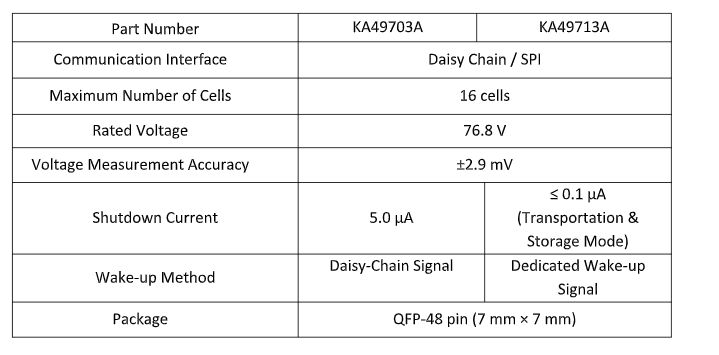
The KA49703A and KA49713A can accurately monitor up to 16 battery cells while integrating communication functions for high- voltage systems and safety features such as cell anomaly detection, addressing the demanding requirements of next generation energy storage systems.
Features of New Product:
1. Daisy-Chain Communication Supporting up to 55 Devices
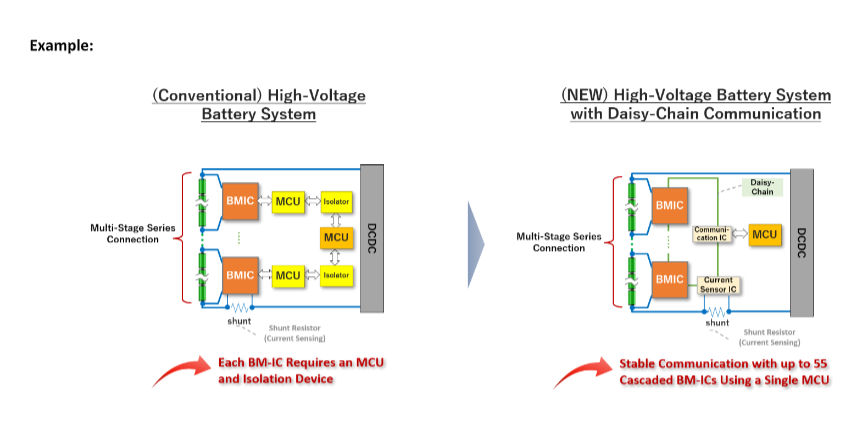
AI-server BBUs and Energy Storage Systems (ESS ) operating at 400V/800V levels require large numbers of lithium-ion battery cells connected in series. Conventional battery monitoring systems typically require a dedicated MCU and isolation device for each monitoring IC. As cell counts increase, component count and communication wiring also increase, creating challenges in communication reliability and system complexity.
To address these issues, the KA49703A and KA49713A incorporate daisy-chain communication technology. Multiple battery monitoring ICs can be connected in series, enabling systems with up to 55 devices while minimizing wiring requirements and ensuring robust communication even in high-voltage environments. This architecture reduces the need for additional MCUs and isolation components, simplifying system design, reducing component count, minimizing board space, and improving overall reliability. The compact QFP-48 package (7 mm × 7 mm) also helps address the stringent space constraints found in AI server BBUs. Combined with high-precision voltage measurement accuracy of ±2.9 mV, the device enhances both monitoring performance and safety in next-generation power systems.
2. Transportation and Storage Mode Reduces Maintenance Costs
AI-server BBUs and large-scale ESS installations contain numerous lithium-ion cells and are often transported over long distances by ship or truck. Minimizing power consumption during transportation and storage is therefore essential.
However, conventional ICs incorporating daisy-chain communication typically exhibit increased shutdown current, leading to
battery drain during storage and transport.
To solve this issue, the KA49713A incorporates a dedicated transportation and storage mode that reduces shutdown current to less than 0.1 μA.
This significantly minimizes battery depletion during transportation and storage, extends allowable storage periods, reduces recharge requirements, and contributes to lower operating costs.
These battery monitoring ICs enable customers to address increasing power demands in the AI era and the transition toward higher-voltage power systems. They support improved reliability and operational efficiency in energy storage systems for data centers, industrial equipment, and social infrastructure.
Through continued expansion of its BM-IC product lineup, Nuvoton will further advance battery monitoring technologies and contribute to realizing a sustainable and highly reliable energy society.
Applications:
・Battery Backup Units (BBUs) for AI servers
・Large-scale Energy Storage Systems (ESS)
Product name:
Industrial Battery Monitoring ICs
・KA49703A
・KA49713A
Specifications:
Start of mass production:
Sep. 2026
Definitions:
- BBU (Battery Backup Unit). A backup power system equipped with rechargeable batteries, such as lithium-ion batteries, that supplies power during outages or momentary voltage drops.
- Daisy-Chain Communication. A communication method in which multiple monitoring ICs are connected in series. It reduces wiring complexity while providing high immunity to electrical noise.
- ESS (Energy Storage System). An energy storage system used for renewable energy integration, peak load management, and power supply-demand balancing.
The post Nuvoton Launches Mass Production of 16-Cell Battery Monitoring ICs with Daisy-Chain Communication for AI Servers appeared first on ELE Times.
Older multitap can capactors, replacement option.
 | I read the different values on each tap in can capactor the get a single matching cap with equal or greater voltage and temp. Then set them as you see on a daughterboard, binding all grounds to a common ground post. Then run wiring to the appropiate terminal or junction of where that value capactor was in the circuit before. I find this way an efficient and orderly way to replace older multi-can capactors. The daughter board is attached to chassis by one or two small, "L" brackets. [link] [comments] |
Ascent Solar broadens thin-film space PV testing beyond NASA’s low Earth orbit results
🎓 Додатковий набір до КПІ ім. Ігоря Сікорського на бакалаврат

У вересні КПІ проводить додатковий набір вступників на навчання за кошти фізичних та/або юридичних осіб (контракт).
Pages




![[link]](https://i.redd.it/8sgnhlj437kh1.jpeg)