


Збирач потоків
INFAC Develops 800V-to-48V Power Conversion Technology to Targets Higher EV Efficiency
South Korea’s INFAC Corporation has introduced a new 800V battery pack design block for electric vehicles that integrates an 800V-to-48V high-power isolated and regulated DC-DC converter. The new design will enhance range, power efficiency and vehicle performance by reducing the need for high-voltage cables and connectors.
Instead of having the DC-DC conversion stage as a distributed, separated subsystem, INFAC’s approach is to convert the battery’s high voltage from 800V to 48V near the battery source so that it can be distributed as a 48V SELV supply across the vehicle. This simplified approach allows lower voltage, versatile, more modular 48V zonal architectures for different EV platforms without replacing battery cells or impacting range.
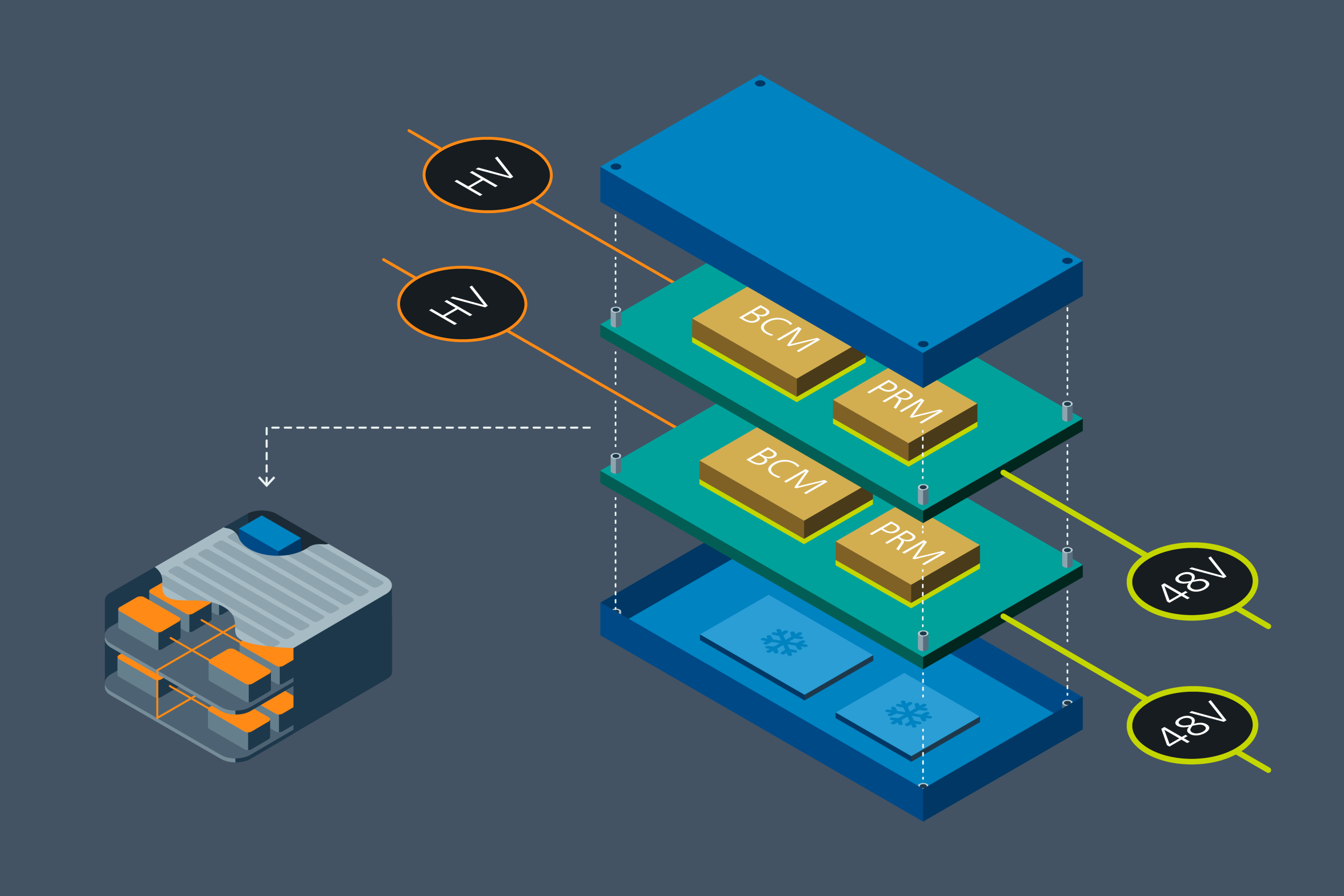
INFAC recognized that traditional approaches to power delivery were misaligned with industry goals for weight reduction, cost optimization and design simplicity.
High voltage DC-DC converters are typically mounted outside the high-voltage (800V or 400V) battery assembly system (BAS), requiring additional safety and thermal management systems. The EV motor and inverter systems demand hundreds of kilowatts of power and require high-voltage wiring harnesses, brackets and enclosures. Other powertrain subsystems and body and chassis electronics require 3.5 – 12kW, and can be easily powered from a 48V SELV zonal power distribution network.
Physically separating the high-voltage source and DC-DC conversion power system unnecessarily duplicates power distribution and management systems, which wastes space, weight and cost and doubles the liquid cooling systems required.
The innovation: Moving DC-DC conversion inside the battery packINFAC’s key insight was that the battery pack already incorporates a robust liquid cooling system for managing thermal loads. By integrating the high voltage DC-DC converter inside the battery, and leveraging the existing infrastructure INFAC eliminated the separate cooling system which traditionally resides outside the battery pack for the DC-DC converter. This departs from conventional “silver-box” design approaches by positioning the battery pack as a central, intelligent power hub rather than a passive energy source.
The change was made using Vicor high-density BCM6135 DC-DC converters and PRM3735 regulators, which provide HV-to-48V conversion and regulation and enable a high-power, fully isolated and regulated bus for the zonal architecture.
Previously, housing the DC-DC conversion function inside the battery pack was impractical as size constraints forced designers to grapple with power management issues, electrical isolation, safety requirements and power module packaging robustness.
Benefits of battery-integrated DC-DC conversionBy co-locating the DC-DC converter within the battery pack, INFAC realized a series of benefits that increased performance at the system level:
- By leveraging the battery’s liquid cooling network, the power module eliminates redundant coolant loops and reduces thermal interfaces.
- High-voltage cable length and thickness are significantly reduced, simplifying high-voltage harness routing and layout.
- Fewer brackets, enclosures and cooling components reduce BOM costs, and weight.
- Minimizing connections and cooling paths reduces leak points and electrical failure risks.
- Fewer external interfaces mean faster, more consistent manufacturing processes.
Vicor high-density, modular power architecture provides the efficiency, scalability and compact form factor required to make battery-integrated 48V distribution practical at scale. In doing so, it positions the battery pack as the central power management and distribution hub for next-generation electric vehicles and enables INFAC to align its EV battery pack designs with the industry’s broader transition toward 48V zonal power architectures.
The post INFAC Develops 800V-to-48V Power Conversion Technology to Targets Higher EV Efficiency appeared first on ELE Times.
🖼 Всеукраїнська виставка «Київ — місто, яке має подобатись»

🖼 У картинній галереї імені Григорія Синиці Центру культури та мистецтв КПІ ім. Ігоря Сікорського відкрилася Всеукраїнська виставка художників та архітекторів «Київ — місто, яке має подобатись».
EPC issues white papers on GaN power conversion for AI data centers and advanced motor drives
Візит задля українсько-японського партнерства

КПІ ім. Ігоря Сікорського прийняв делегацію Палати представників Японії на чолі з її головою Морі Ейсуке, членом Палати представників Масахіто Моріяма, а також Надзвичайним і Повноважним Послом Японії в Україні Осумі Йо разом із представниками Посольства Японії.
Caliptra-enabled hardware security solution eyes AI SoCs

A production-ready root-of-trust and security orchestration solution provides dedicated hardware-level security for mission-critical data center and AI system-on-chips (SoCs). This enterprise-grade solution also accelerates design deployment with a complete hardware and software integration framework that includes dedicated drivers, APIs, and system-level security applications.
Rambus’ CryptoManager Root of Trust provides dedicated hardware-level security in an SoC design by combining a secure RISC-V processor, protected memory, secure key and data storage, cryptographic accelerators, and secure interfaces.
CryptoManager operates alongside an unmodified open-source Caliptra Project core, mediating interactions between the Caliptra Project core, the host processor, and other SoC components. This ensures security-sensitive operations remain within a protected boundary while extending trust across the wider platform.
CryptoManager’s root-of-trust and security orchestration are interoperable with Caliptra, an open-source security framework for silicon root of trust designed for integration into data center-class SoCs. Originally an Open Compute Project (OCP) initiative, it’s currently developed within the CHIPS Alliance.
Caliptra combines hardware, firmware, and specifications to provide a common foundation for device identity, measured boot, and attestation across CPUs, GPUs, AI accelerators, DPUs, networking devices, and other infrastructure components.
“As the Caliptra ecosystem gains momentum, organizations need a practical path to deploy scalable and supportable security solutions in demanding production environments,” said Simon Blake-Wilson, senior VP and GM of silicon IP at Rambus. “CryptoManager Root of Trust supporting the Caliptra specification provides the hardware, software, advanced protections and commercial support needed to accelerate deployment of differentiated enterprise-grade security that is interoperable with the Caliptra framework.”

CryptoManager Root of Trust combines enterprise-grade security with simplified integration and certification readiness for data center and AI SoCs. Source: Rambus
CryptoManager supports classical, post-quantum, and regional cryptographic algorithms. It also provides advanced protections against side-channel and fault-injection attacks, as well as certification support for security standards such as FIPS 140-3 and SESIP.
Furthermore, CryptoManager employs specialized drivers and security applications to offer platform-level awareness, enabling security monitoring, policy enforcement, secure lifecycle management, and coordinated protection of critical system resources.
This platform-wide security awareness, combined with proven side-channel and fault-injection protections, facilitates cryptographic agility for a low-risk path to volume implementations of highly secure data center and AI semiconductor devices.
Related Content
- When AI Meets Hardware Security
- IoT security: Challenges and solutions
- Hardware Root of Trust Essential for AI Chip Integrity
- Hardware security verification must go beyond functional testing
- Hardware Security Requirements for Embedded Encryption Key Storage
The post Caliptra-enabled hardware security solution eyes AI SoCs appeared first on EDN.
Захар Гарник (1998 – 2026)

🇺🇦 Захар Гарник - студент першого курсу Навчально-наукового фізико-технічного інституту КПІ ім. Ігоря Сікорського.
Богдан Канєвський (24.05.1998 – 08.09.2026)

Богдан Канєвський здобув освіту в Навчально-науковому видавничо-поліграфічному інституті КПІ ім. Ігоря Сікорського за спеціальністю «Видавництво та поліграфія». Згодом вступив до аспірантури та викладав на кафедрі репрографії.
КПІ ім. Ігоря Сікорського — переможець конкурсу CampeX з розбудови кампусів досконалості в Україні

🚀 КПІ став одним із 12 університетів — переможців конкурсу CampeX з-поміж 27 учасників за напрямом «Космічні технології».
UK’s Battalion and Penn State launch research collaboration focused on national security
Eggtronic introduces high-efficiency 140W USB-C Power Delivery reference design
🔊 Вступ до кафедри військової підготовки КПІ

На кафедрі військової підготовки КПІ продовжується додатковий набір з підготовки громадян України за програмою підготовки офіцерів запасу за 7 спеціальностями:
Європейський досвід для України: літня академія в Баварії

Асистентка кафедри біоенергетики, біоінформатики та екобіотехнології ФБТ Діна Колтишева цього літа взяла участь у літній академії Баварської адміністрації з охорони навколишнього середовища (Summer academy of the Bavarian environmental administration). Навчання, чи, радше, стажування це проходило в місті Хоф.
SEMI joins ReSiLient consortium to strengthen Europe’s silicon and SiC raw material value chains
VU meter with LM324N Quad op-amps
 | Components required: Breadboard (optional) 1× LM324N 4× 1kΩ Resistors 1× 220kΩ Potentiometer (to adjust reference voltage) 4× LEDs (I'm using random colours because this is a prototype) 1× 220Ω Resistor 5V Supply Earphone Jack (as an input) Some cables and staplers (used by me) Audio Amplifier* wiring diagrams will be posted here, or visit the link in the comment section ^-^ *Connect the input of the VU meter to an audio amplifier with separate power supply [link] [comments] |
Radon sensor embeds sizeable alpha particle detector

PIN photodiode collects, counts, and discriminates alpha energies to determine residences’ radon gas-caused cancer danger degrees.
Back in late July, when I was working on last month’s published piece on radon gas analysis, I longed to see what was inside the battery-operated sensing device I’d recently started using.

But I resisted the temptation to fire up the spudger and screwdriver set, because:
- I’d bought it myself, for $100+, and
- I intended to continue using it long-term, since radon gas concentrations vary over time.
Even if I trusted my ability to disassemble it and then put it back together again in still-full-functional form (which I don’t), I didn’t want to interrupt the data-logging cadence even briefly.
But Providence seemingly intervened on my behalf, as counterbalance to my reticence. Less than a week after my post appeared, a PR contact from Chinese company X-Sense, who swore she hadn’t even seen my coverage yet, reached out to see if I was interested in reviewing its latest consumer-tailored smart radon alarm, the just-introduced XR0A-iR. The device is so new that it only showed up on the company website a few days ago, as I write this on September 10, 2026.


Spooky, eh?


I accepted the invitation with the as-usual qualifiers in such situations: that the company would not see my coverage until it appeared in publicly published form on EDN’s website, and that X-Sense would have no ability to influence the content either in-advance or post-publication. The PR contact agreed.
I also asked for two units; one for hands-on testing (for which I planned to recruit my next-door neighbor, both because he didn’t have one yet and because I wanted to get a non-techie’s take on activation and ongoing use) and the other to satisfy my own teardown curiosity.
Smart equals pervasive data accessX-Sense agreed again. And late last month, two units showed up at my front door. My next-door neighbor successfully activated his yesterday; stay tuned for his hands-on observations to come in a future post. And that same (yester)day, I took the other one apart.
X-Sense is a smart home device manufacturer of which I wasn’t previously aware. The company’s products are analogous to those (for example) of TP-Link, whose Kasa and Tapo temperature, humidity and fluid leak sensors I’ve dissected in recent months. X-Sense already had two radon sensors in its product portfolio, the XR0A-SR and higher-end XR0B-SR, but they’re standalone-use units. The XR0A-iR is its first “connected” radon-related product.
I’ll as-usual start with some outer box shots, accompanied by a 0.75″ (19.1 mm) diameter U.S. penny for size comparison purposes. Top.

Front.

Left side.

Back.

Right side.

And bottom.

The first thing you’ll see after removing the box lid is a comprehensive and consumer-comprehensible (those adjectives rarely get used together, in a positive sense, at least!) user guide.

Underneath it is our patient.

Surrounded by two mysterious baggies.

I jest; they’re not mysterious, because they’re labeled. One, containing silica gel, I commonly encounter to absorb humidity, thereby keeping the electronics dry. The other, marked as indicating that inside it was activated charcoal, was a bit more of an initial head-scratcher.

But then I recalled the mail-in radon lab test (mentioned in my prior writeup) that my wife and I ordered prior to purchasing our home a decade-plus ago, and which looked something like this.

I rattle sound-suspected at the time, and subsequent research has confirmed, that inside it was activated charcoal, used both for short-duration testing and (interestingly, at least to me) for filtering radon out of well water. That said, it’s not recommended for ongoing residential-air radon gas cleansing purposes. Here, I’m guessing, it absorbs ambient radon gas at warehouses and retailer shelves that would otherwise end up on the device’s sensor, adversely affecting subsequent initial-powerup measurement results in the process.
Onward. Here’s our patient, now freed from its previous cardboard captivity. Top (note the grille; hold that thought).

Front.

Left side (note the vents).

Back.

Right (ditto).

And bottom.

Before beginning the dissection, here’s an obligatory company-supplied conceptual image of the supposed “guts”, that I know you all love so much (me too).

The battery compartment often effectively does double-duty as the pathway inside the device. Let’s see if it pans out again.


Those four screw heads, one at each corner, look promising. The unit specs a 2-year (and user-replaceable) battery life claim, by the way. Not too shabby!

Before proceeding, though, let’s zoom in on the always-informative FCC ID (2AU4DDDM).

And now for those pesky screws.


Ladies and gentlemen, we’ve hit the jackpot!


Those white glue deposits at both flex cable-to-connector junctions initially gave me pause. Was I not going to be able to keep this teardown non-destructive, always my preference?


Not so “gluey” after all, it turned out. Never mind. Keep calm and carry on.

Let’s focus our attention first on the top panel and interior of the upper enclosure.

Four more visible screw heads suggest a way to detach the former from the latter. Let’s see.


Bingo!

And now for another perspective, after flipping the enclosure over.

Setting the top panel aside for the moment, we now see that two more screws hold the display assembly in place.

You know what comes next.


And there she goes.


Removing four more screws, I’m betting, will give us a glimpse of the display backside.


I’m on a roll! It’s usually at about this time of inflated self-confidence, by the way, when I short out something, or cut myself and bleed all over everything. Consider yourself warned.


Now for the top panel, and maybe the most baffling aspect of this design. Look back at the earlier top-side overview shot, and you’ll see what appears to be a grille. We already know from the box-bottom notations that this is a passive diffusion design; no (noisy and battery-draining) fans, only natural airflow through the device. Does it flow through the top?
The fact that the documentation only notates the earlier-seen enclosure side vents as “air intake areas” is head-scratching. And when you look at the grille from the inside, you see a black piece of plastic nearly completely covering it. So “nope” is apparently the answer to my question.


So, then, why is it here at all? The earlier-mentioned high-end standalone XR0B-SR model has a speaker up top and behind the grill, for audible-alert purposes.

But it’s also got buttons up top, versus in the front with this particular model, so it’s not like X-Sense can reuse any particular assemblage piece across multiple models.

My only other possible conclusion is that the company is striving to establish a common cosmetic “look” across all models. To wit, ironically, I suspect that the purpose of that black plastic piece is to prevent ambient airflow from going in and/or out the top, forcing it to instead route from one side to the other, presumably over the sensor in the process. Other reader ideas are welcomed in the comments!
Speaking of which, that varying black foam-and-shiny silver plastic circular region up top, held in place by an also-plastic brace, looks promising as a potential radon sensor location.

Let’s see what’s inside it, after first perusing other varying-location perspectives of the overall internal assemblage. Front.

Left side.

Back.

And right side.

I’ve delayed entry, thereby building suspense, more than enough at this point. Here goes nothing.


This looks promising.

We’ve hit pay dirt (although a subsequent Google search on the “CD2026MAR6729” mark wasn’t, alas, even remotely fruitful)!


Upside-down temporary reinsertion into the cavity affords us a closer perspective.

Again, referencing the bottom packaging information, which described the unit’s measurement method as “continuous alpha spectrometry”, this is, I believe (readers?) a solid-state PIN photodiode, described along with other possible implementation approaches in a useful online reference that I came across during my research.
As the acronym suggests, the heavily doped p-type and n-type semiconductor regions, used (among other things) as ohmic contacts, are separated by an intermediary un-doped intrinsic semiconductor region.

The conceptual visual similarity with a multi-pixel image sensor is likely already obvious.

In this case, however, where (i.e. in a particular x:y pixel grid coordinate combination) an alpha particle has struck the semiconductor medium isn’t relevant; that one has struck is all that’s necessary to determine. The sensor normally points downward; the surrounding plastic is obviously no functional impediment. In the following photo, I put the assembly back together so you can see the routing of the seeming single-wire (surprisingly, at least to me) harness out of it.

We still haven’t found the system’s intelligence and wireless connectivity, however. The prior internal assembly front view image suggests there’s a PCB underneath the sensor. Let’s see.


Here it is.


Let’s next see what’s underneath that shiny plastic cover.


A mess of passives (along with a few five-lead ICs, likely single-package dual-transistor devices) is admittedly not what I expected to find. Then again, as I’ve confessed plenty of times before, analog is admittedly not my area of particular expertise.


Two more screws to go.


And the comparatively boring PCB backside is now accessible for visual perusal.


Yawn…unless you’re into switches, test points and/or battery terminals, that is. Let’s give the PCB frontside one more now-standalone look.

The combo 2.4 GHz Wi-Fi plus Bluetooth LE module at left, with a common-frequency, combo-protocol antenna sticking out of it, is the Ai-WB2-32S kit from a previously-unknown-to-me company called AI-Thinker. Is there something explicitly AI-related to this particular product (and/or the manufacturer, more generally)? Or is it just one of those cases nowadays where anything sounds more important if you tack “AI” onto it? The under-Faraday-Cage photo published at the webpage is woefully low-res, but hey, there’s also a spec sheet.

And at center is the system’s processing nexus, the 32-bit Arm Cortex M4-based N32L406MBL7 microcontroller from another new-to-me supplier, Nations Technologies. It has onboard flash memory and SRAM, thereby explaining why I don’t see any discrete memories on the PCB.
Last, but not least, after carefully putting everything back together, the device fired right up.

It’s a miracle!
That’s a wrap for today, folks. As always, reader insights are welcomed in the comments!
—Brian Dipert is the associate editor, as well as a contributing editor, at EDN.
Related Content
- Radon: Level detection, risk determination, and as-needed mitigation
- Improve HVAC efficiency with accurate sensors
- My Geiger counter doesn’t count (sob sob)
- Design femtoampere circuits with low leakage, part 1 and part 2
The post Radon sensor embeds sizeable alpha particle detector appeared first on EDN.
Why India Needs Smarter and More Standardised EV Charging Infrastructure
India’s rapidly expanding network of electric-vehicle chargers still faces a host of technical and deployment challenges. According to one recent report, a significant gap remains between the infrastructure currently available and the charging stations that could be needed as EV adoption increases. The challenges with the charging infrastructure extend beyond simply increasing the number of chargers and include charger reliability, power capacity, grid connectivity and technical standardisation.
Non-Functional EV Chargers Highlight Reliability ChallengeSome common issues include non-operational chargers. EV chargers can be installed but become non-operational or unavailable due to communication issues, power failures, equipment failures, and poor maintenance. To maximise charger uptime, real-time monitoring, diagnostics, remote fault detection and maintenance are needed.
India Needs More Heavy-Duty and Highway ChargingThe charging requirements of electric cars, buses and commercial vehicles all differ. Heavy-duty electric vehicles, in particular, will need high-power charging systems that can deliver a lot of energy in a short period of time, making high-powered chargers, grid connections, thermal management and power-electronics systems critical areas for research and development.
Standardisation Can Improve EV Charging CompatibilityAnother important challenge is the technical inconsistency of the implementations of charge points on the market. Standardised communication protocols, connector types, charging profiles and interoperability requirements can enable chargers to work more harmoniously with different EVs and charge networks.
The charging ecosystem can be further optimised through the use of smart charging technologies. Load management, real-time load monitoring, dynamic power distribution and solar integration can enable chargers to make more efficient use of available grid capacity.
The post Why India Needs Smarter and More Standardised EV Charging Infrastructure appeared first on ELE Times.
Rare-Earth-Free EV Motors: How India Could Reduce Dependence on Critical Magnet Materials
India is exploring new electric-motor technologies that may help the electric vehicle (EV) industry reduce reliance on rare-earth permanent magnets. During the recent New Delhi deep-tech showcase, Indian innovators introduced a rare-earth-free electric powertrain, reflecting the country’s growing focus on developing alternative motor technologies free of rare-earth materials.
Chara Technologies, which is based in Bengaluru, was among the companies showcased. The company has built rare-earth-free synchronous reluctance motors and controllers for electric mobility. It uses materials that are indigenously sourceable materials and does not require rare-earth permanent magnets, which are commonly used in many high-performance electric motors. Chara’s motor platform covers 8 kW-30 kW, and the products are ARAI- and ICAT-certified.
Why Rare-Earth-Free Motors Matter for EVsIndia currently imports all of its downstream sintered NdFeB rare-earth permanent magnet demand. These high-efficiency magnets are preferred in electric vehicle motors due to their high magnetic properties, which support compact and high-power density motor designs. Although India has some large deposits of rare-earth minerals, as with many other processing countries, India is not yet equipped with industrial-scale midstream facilities to convert rare-earth oxides into metals, alloys, and magnets and is therefore reliant on imports of sintered NdFeB magnets.
India’s Push for Alternative EV Motor TechnologyIndia’s EV manufacturers could reduce reliance on imported rare-earth magnet supply chains by adopting rare-earth-free motors, which can enable greater use of locally sourceable materials and manufacturing capabilities. However, these motors will be commercially successful only if they offer comparable or better efficiency, power density, cost, thermal performance, reliability and scalability.
The post Rare-Earth-Free EV Motors: How India Could Reduce Dependence on Critical Magnet Materials appeared first on ELE Times.
India Tightens EV Localisation Rules, Putting Traction Motor Technology in Focus
India is moving toward higher domestic manufacturing of key electric-vehicle drivetrain components that deliver mechanical power from the electric motor to the driving wheels. The Ministry of Heavy Industries (MHI) has strengthened localisation requirements for EV buses and trucks under the PM Electric Drive Revolution in Innovation Vehicle Enhancement (PM E-DRIVE) initiative.
The new amendments under Phased Manufacturing Programme (PMP) for M2/M3 e-buses and N2/N3 e-trucks will ensure higher local manufacturing of traction, motor controllers and other powertrain-related components from September 1, 2026.
Localisation requirements will also extend to traction-motor controllers, including inverters, from April 1, 2027. The revised requirements include domestic assembly of electronic components, semiconductor devices and connectors directly on printed circuit boards, along with the fitment of high-voltage connectors, cables, heat sinks, enclosures, and software or firmware flashing.
India wants EV manufacturers to source more components locally. However, many traction motors use rare-earth magnets, for which India depends significantly on imports. Export restrictions have disrupted the supply of these magnets. Therefore, SIAM asked the government to extend the September 1, 2026, localisation deadline.
The post India Tightens EV Localisation Rules, Putting Traction Motor Technology in Focus appeared first on ELE Times.
Indian Army Launches AASHVAST Lab to Detect Chinese Components and Cyber Threats
To strengthen the security of military drones and identify hidden security such as hidden software threats and potential cyber vulnerabilities (specifically of Chinese origin), India Army has established a dedicated laboratory in New Delhi. Named AASHVAST (Assessment and Analysis of Electronic Systems Hardware for Vulnerabilities and Security Threats), the laboratory was inaugurated by the chief of Army Staff, General Dhiraj Seth at the Directorate General of Electronics and Mechanical Engineering (DG EME) premises in Delhi Cantonment on August 14, 2026.
The lab is designed to scan, analyse, and assess military drones to identify hidden security threats by examining both the hardware and software systems of military drones. The lab can help identify security risks that conventional physical inspections may not reveal. It can scan for hidden passwords, embedded encryption keys, remote-access tools, unauthorised command pathways and other vulnerabilities that could potentially be exploited to compromise unmanned aircraft.
An important aspect of AASHVAST is the air-gapped and read-only operating environment which enables the software and firmware to be examined without connecting the system to an external network or making any changes to the hardware under assessment. Technicians and authorised officers receive a consolidated view of the identified risk after vulnerabilities are ranked by severity and converted into a structured security assessment.
The post Indian Army Launches AASHVAST Lab to Detect Chinese Components and Cyber Threats appeared first on ELE Times.
AeroVironment Receives First International Order for LOCUST Laser System
AeroVironment announced that it received the first international order for its LOCUST High-Energy Laser Counter-Unmanned Aircraft Systems for over $50 million and that it will supply a number of systems with support, which, according to the company, is “an enabling milestone in the international adoption of directed-energy air defence”. LOCUST combines sensors, tracking and laser defeat against group 1-3 Unmanned Aircraft Systems and other airborne targets. It can be implemented in a fixed, palletized, or mobile configuration and integrated with a wide range of available external sensors and command-and control networks.
A single shot with a LOCUST engagement could cost AeroVironment under $10. That alone presents a huge advantage for laser against cheap, widely produced drones, since air-defence missiles could end up costing much more than the drone. Additionally, there are no traditional interceptor reload limitations on laser weapons-though their performance will still vary by availability of power, conditions, range, and visibility and the world order is adopting AeroVironment’s choice in a $464.8 million contract with the U.S. Army for high-energy laser production, and has ordered over $30 million in new investments in their Albuquerque campus facility, in an environment increasingly calling for layered counter-drone defences.
The post AeroVironment Receives First International Order for LOCUST Laser System appeared first on ELE Times.
Сторінки




![[link]](https://i.redd.it/3dv6aiiehhph1.jpeg)