


Збирач потоків
Звіт проректора з розвитку інфраструктури КПІ Олександра Мирончука на засіданні Вченої ради 15 грудня 2025 року "Розвиток інфраструктури університету: досягнення 2025 року"

Шановні колеги, рік тому у цих стінах Вчена рада затвердила Стратегію розвитку університету на 2025-2030 роки. У цьому документі визначено бачення нашого майбутнього, пріоритетні цілі та завдання. Сьогодні ми розглянемо досягнення Університету за 2025 рік, що стосуються розвитку його інфраструктури.
Toxics Link study Finds a Long Road to Circularity in India’s E-waste EPR Model
A new report by an environmental group, Toxics Link, reveals significant structural gaps in India’s Extended Producer Responsibility (EPR) framework for e-waste. The study, titled “Long Road to Circularity,” warns that while the EPR model is a cornerstone of waste management, it currently fails to capture a vast range of critical minerals essential for India’s green transition.
The Extended Producer Responsibility (EPR) framework mandates the recovery of only four metals—gold, copper, iron, and aluminium—leaving critical metals untapped. A vast range of valuable and critical metals, including neodymium, dysprosium, and lithium, are essential to strengthening resource security but is currently overlooked and lost.
In light of these concerns, the report examines current e-waste regulations and highlights critical challenges limiting their effective implementation. The report also underscores persistent issues, including low consumer awareness, poor financial traceability of e-waste flow and limited monitoring capacities. The study identifies several operational gaps. Key findings from the report include:
- The EPR portal currently lacks data on total market players and leaves small-scale manufacturers, online sellers, and grey-market importers outside the system.
- Information regarding non-compliance penalties and environmental compensation remains unavailable for the 2023–24 and 2024–25 fiscal years.
- Detailed data is accessible only to operators, resulting in limited public visibility into system performance.
- The current regulation does not identify and place responsibility on any individual stakeholder for the setting up of collection centres, thus making it extremely difficult for consumers to deposit their waste in the authorised e-waste stream.
- No incentive to producers and manufacturers adopting “green” product designs or for recyclers implementing high-quality, advanced recovery processes.
“While Extended Producer Responsibility is a cornerstone of India’s e-waste management framework, the principle alone cannot deliver the desired outcomes. It must be complemented by an effective and robust waste collection system, integrating the informal sector and the development of high-tech recycling facilities along with public awareness for advancing system transparency”, Satish Sinha, Associate Director, Toxics Link.
The report suggests the following key recommendations to plug some of the gaps in the
present system:
- Enhance system accountability and transparency by making data accessible to the
public. - Strengthen reverse supply chains and collection mechanisms to streamline the flow
of e-waste. - Expand consumer awareness on the advantages of e-waste recycling and the
importance of using authorised collection channels. - Integrate the informal sector into the e-waste management ecosystem.
Together, these measures can help build a stronger and more effective e-waste
management system.
The post Toxics Link study Finds a Long Road to Circularity in India’s E-waste EPR Model appeared first on ELE Times.
ESGDS’ AI platform slashes data processing time by 98% with MongoDB Atlas
ESG Data & Solutions (ESGDS) is a fast-growing Indian technology company. It builds tools to enable banks, investors, and other financial groups to track and analyse a company’s performance on Environmental, Social, and Governance (ESG) issues.
With a vast range of covered topics and multiple providers employing different types of methodologies and taxonomies, ESG data sets are notoriously difficult to work with.
Because these analyses guide critical research and investment decisions, ESGDS developed ESGSure—a bespoke research platform built on MongoDB Atlas—to address the challenge.
THEIR CHALLENGE: Overcoming the relational model limitations to unlock AI scale
ESGSure collects points from over 20,000 companies and investors—these include annual reports and corporate filings, news, and client-specific questionnaires. The platform also tracks a range of other publicly available sources, including news articles, compliance records, and sanctions lists, among others. These resources come in various formats, including videos, PDFs, transactional data in APIs, and more.
Before moving to MongoDB Atlas, ESGDS relied on several other databases, including relational databases such as PostgreSQL and Pinecone for vector search workloads. As the use cases and data sets expanded, ESGDS encountered limitations.
“Our platform needs to process massive, diverse, and unstructured data sets, so we can then use a combination of large language models (LLMs), real-time data, and vector search capabilities to deliver AI-driven granular, personalised, and actionable insights for investors,” said Arun Doraisamy, Co-Founder and Chief Technology Officer at ESGDS. “We needed more flexibility, to reduce complexity, and do that at scale. This meant moving away from a relational model and onto a database model that fit our needs.”
Several limitations drove ESGDS to seek a new database:
- Lack of flexibility and scalability: Rigid legacy relational databases lacked the schema flexibility required to dynamically store and update ESGDS’s rapidly evolving datasets. This resulted in inconsistent insights that hindered analysts’ and investors’ ability to make timely and accurate data-driven decisions. Additionally, a lack of elastic scalability throttled ESGDS’s ability to handle continuous data growth, compromising its ambitious expansion plans.
- Delayed data insights: Stale data is a significant challenge for the ESG data analysis industry—by the time it is collected and analysed, ESG data can be up to a year old. To add to this challenge, manual ESG data review in ESGDS’s legacy database took an average of 2 to 3 days per company. ESGDS wanted to automate these processes to provide investors with real-time insights.
- Complex security and compliance: ESGDS manages sensitive, private datasets for its clients. Ensuring secure storage, data encryption, and compliance with ESG frameworks and regional requirements, such as GDPR, has become increasingly complex. With expansion into highly regulated countries on its roadmap, ESGDS knew this challenge would become acute.
- Limited global portability: ESGDS needed a data platform that would easily and efficiently power growth plans across Europe, Asia Pacific, and North America. It had to support a reliable, multi-cloud, and multi-region infrastructure.
“We needed a modern, flexible model with built-in AI capabilities that could meet our complex needs, and keep evolving to support our ambitious growth and diversification goals,” said Doraisamy.
The post ESGDS’ AI platform slashes data processing time by 98% with MongoDB Atlas appeared first on ELE Times.
🚀 Триває опитування «Викладач очима студентів»

Хочете вплинути на якість викладання? Візьміть участь в опитуванні «Викладач очима студентів» в Електронному кампусі щодо якості викладання науково-педагогічними працівниками протягом минулого семестру. Це єдине офіційне опитування, яке ОБОВ’ЯЗКОВО враховується при проходженні викладачем конкурсу.
Photon Bridge demos >30mW laser output per color at wafer scale on silicon photonics
AI is stress-testing processor architectures and RISC-V fits the moment

Every major computing era has been defined not by technology, but by a dominant workload—and by how well processor architectures adapted to it.
The personal computer era rewarded general-purpose flexibility, allowing x86 to thrive by doing many things well enough. The mobile era prioritized energy efficiency above all else, enabling Arm to dominate platforms where energy, not raw throughput, was the limiting factor.
AI is forcing a different kind of transition. It’s not a single workload. It’s a fast-moving target. Model scale continues to expand through sparse and mixture-of-experts techniques that stress memory bandwidth and data movement as much as arithmetic throughput. Model architectures have shifted from convolutional networks to recurrent models to transformers and continue evolving toward hybrid and emerging sequence-based approaches.
Deployment environments span battery-constrained edge devices, embedded infrastructure, safety-critical automotive platforms, and hyperscale data centers. Processing is spread across a combination of GPUs, CPUs, and NPUs where compute heterogeneity is a given.
The timing problem
Modern AI workloads demand new operators, execution patterns, precision formats, and data-movement behaviors. Supporting them requires coordinated changes across instruction sets, microarchitectures, compilers, runtimes, and developer tooling. Those layers rarely move in lockstep.
Precision formats illustrate the challenge. The industry has moved from FP32 to FP16, BF16, INT8, and now FP8 variants. Incumbent architectures continue to evolve—Arm through SVE and SVE2, x86 through AVX-512 and AMX—adding vector and matrix capabilities.
But architectural definition is only the first step. Each new capability must propagate through toolchains, be validated across ecosystems, and ship in production silicon. Even when specifications advance quickly, ecosystem-wide availability unfolds over multiple product generations.
The same propagation dynamic applies to support sparsity, custom memory-access primitives, and heterogeneous orchestration. When workloads shift annually—or faster—the friction lies both in defining new processor capabilities and in aligning the full stack around them.

Figure 1 AI imposes multi-axis stress on processor architectures.
Traditional ISA evolution cycles—often measured in years from specification to broad silicon availability—were acceptable when workloads evolved at similar timescales. But they are structurally misaligned with AI’s rate of change. The problem is that architectural models optimized for long-term stability are now being asked to track the fast-paced and relentless reinvention of workloads.
The core issue is not performance. It’s timing.
Differentiate first, standardize later
Historically, major processor architectures have standardized first and deployed later, assuming hardware abstractions can be fully understood before being locked in. AI reverses that sequence. Many of the most important lessons about precision trade-offs, data movement, and execution behavior emerge in the development phase, while the models are still evolving.
Meta’s MTIA accelerator (MTIA ISCA23/MTIA ISCA25) makes use of custom instructions within its RISC-V–based processors to support recommendation workloads. That disclosure reflects a broader reality in AI systems: workload-specific behaviors are often discovered during product development rather than anticipated years in advance.

Figure 2 MTIA 2i architecture comprises an 8×8 array of processing elements (PEs) connected via a custom network-on-chip.

Figure 3 Each PE comprises two RISC-V processor cores and their associated peripherals (on the left) and a set of fixed-function units specialized for specific computations or data movements (on the right).
The MTIA papers further describe a model—a hardware co-design process in which architectural features, model characteristics, and system constraints evolved together through successive iterations. In such environments, the ability to introduce targeted architectural capabilities early—and refine them during development—becomes an engineering requirement rather than a roadmap preference.
In centrally governed compute architectures, extension priorities are necessarily coordinated across the commercial interests of the stewarding entity and its licensees. That coordination has ensured coherence, backward compatibility, and ecosystem stability across decades.
It also means the pace and priority of architectural change reflect considerations that extend beyond any single vendor’s system needs and accumulate costs associated with broader needs, legacy, and compatibility.
The question is whether a tightly coupled generational cadence—and a centrally coordinated roadmap—remains viable when architectural optimization across a vast array of use cases must occur within the product development cycle rather than between them.
RISC-V decouples differentiation from standardization. A small, stable base ISA provides software continuity. Modular extensions and customizations allow domain-specific capabilities within product cycles. This enables companies and teams to innovate and differentiate before requiring broad consensus.
In other words, RISC-V changes the economics of managing architectural risk. Differentiation at the architecture level can occur without destabilizing the broader software base, while long-term portability is preserved through eventual convergence.
Matrix-oriented capabilities illustrate this dynamic. Multiple vendors independently explored matrix acceleration techniques tailored to their specific requirements. Rather than fragmenting permanently, those approaches are informing convergence through RISC-V International’s Integrated Matrix Extensions (IME), Vector Matrix Extensions (VME), and Attached Matrix Extensions (AME) working groups.
The result is a path toward standardized matrix capabilities shaped by multiple deployment experiences rather than centralized generational events that need consensus ahead of time.
Standardization profiles such as RVA23 extend this approach, defining compatible collections of processor extensions while preserving flexibility beneath the surface.
In practical product terms, this structural difference shows up in development cadence. In many established architectural models, product teams anchor around a stable processor core generation and address new workload demands by attaching increasingly specialized accelerators.
Meaningful architectural evolution often aligns with major roadmap events, requiring coordinated changes across hardware resources, scheduling models, and software layers. By contrast, RISC-V’s base-and-extension model allows domain-specific capabilities to be introduced incrementally on top of a stable ISA foundation.
Extensions can be validated and supported in software without requiring a synchronized generational reset. The distinction is not about capability; it’s about where, when, and how innovation occurs in the product cycle.
From inference silicon to automotive
This difference becomes apparent in modern inference silicon.
Architectural requirements—tightly coupled memory hierarchies, custom data-movement patterns, mixed-precision execution, and accelerator-heavy fabrics—are often refined during silicon development.
Take the case of D-Matrix, which has selected a RISC-V CPU for vector compute and orchestration, memory, and workload distribution management for its 3DIMC in-memory compute inference architecture. In architectures where data movement and orchestration dominate energy and latency budgets, the control plane must adapt alongside the accelerator. Architectural flexibility in the control layer reduces development iteration friction during early product cycles.
The tension between architectural stability and workload evolution is especially visible in automotive.
ISO 26262 functional safety qualification can take years, and vehicle lifecycles span a decade or more. Yet advanced driver assistance systems (ADAS) depend on perception models that are continuously evolving with improved object detection, sensor fusion, and self-driving capabilities. As a result, the automotive industry faces a structural tension: freeze the architecture and risk falling behind or update continuously and requalify repeatedly.
A stable, safety-certified RISC-V foundation paired with controlled extensions offers one way to balance those forces—architectural continuity where validation demands it, and differentiation where workloads require it.
This approach has industry backing. Bosch, NXP, Qualcomm, Infineon, and STMicroelectronics have formed Quintauris specifically to standardize RISC-V profiles for automotive, targeting exactly this combination of long-term architectural stability with application-layer adaptability.
The fact that this represents hardware suppliers, microcontroller vendors, and system integrators simultaneously reflects how broadly the industry has recognized the problem and the approach.
A moment defined by engineering reality
RISC-V’s expanding role in AI is not a rejection of incumbent architectures, which continue to deliver performance and compatibility across a wide range of systems. It reflects a shift in engineering constraints highlighted by AI’s pace.
When workloads evolve faster than architectural generations, adaptability becomes an economic variable. The architecture that prevails is not necessarily the one that runs today’s models fastest. It’s the one that can adjust when those models change.
Legacy processor architectures provide broad stability across generations. RISC-V adds a structural advantage in adaptation velocity—the ability to accommodate differentiation within the product cycle, absorb lessons from deployment, and converge toward standardization—without forcing system architects to wait for generational events. It can adapt to tomorrow’s workloads and course-correct without breaking yesterday’s software.
Marc Evans is director of business development and marketing at Andes Technology USA, a founding premier member of RISC-V International. He is also the organizer of RISC-V Now! (www.riscv-now.com) to be held in Silicon Valley on April 20-21, 2026, a conference focused on the practical lessons of deploying RISC-V at commercial scale across AI, automotive, and data centers.
Special Section: AI Design
- The AI design world in 2026: What you need to know
- AI workloads demand smarter SoC interconnect design
- AI’s insatiable appetite for memory
- The AI-tuned DRAM solutions for edge AI workloads
- Designing edge AI for industrial applications
- Round pegs, square holes: Why GPGPUs are an architectural mismatch for modern LLMs
- Bridging the gap: Being an AI developer in a firmware world
- Why power delivery is becoming the limiting factor for AI
- Silicon coupled with open development platforms drives context-aware edge AI
- Designing energy-efficient AI chips: Why power must Be an early design consideration
- Edge AI in a DRAM shortage: Doing more with less
- AI in 2026: Enabling smarter, more responsive systems at the edge
The post AI is stress-testing processor architectures and RISC-V fits the moment appeared first on EDN.
Keysight Unveils 3D Interconnect Designer for Chiplet and 3DIC Advanced Package Designs
Keysight Technologies introduced 3D Interconnect Designer, a new addition to its Electronic Design Automation (EDA) portfolio. The solution addresses the mounting complexity of designing 3D interconnects for high-chiplet and 3DIC advanced packages used in AI infrastructure and data centre applications.
As chiplet architectures are increasingly adopted, engineers face complex 3D interconnect designs for multi-die and stacked-die applications, which traditional workflows struggle to handle efficiently. As a result, teams spend significant time manually optimising the interconnects that include vias, transmission lines, solder balls, and micro-bumps while ensuring signal and power integrity in densely packed systems. This results in more design spins and longer product development cycles, creating a bottleneck that can delay product launches and increase development costs.
Keysight EDA software streamlines the process with a dedicated workflow for designing and optimising 3D interconnects accurately. The tool handles complex geometries, including hatched or waffled ground planes, which are critical to overcome manufacturing and fabrication constraints, especially silicon processes such as interposers and bridges, in advanced package designs. By enabling engineers to quickly design, optimise, and validate 3D interconnects used in chiplets and 3DICs, it minimises iterations and speeds time-to-market.
Key benefits include:
- Accelerates Design Cycles: Streamlined automation removes time‑consuming manual steps in 3D interconnect design, minimising errors and boosting first‑pass success
- Reduced Compliance Risk: Validates designs against emerging standards such as UCIe and BoW, ex VTF (Voltage Transfer Function), early in the lifecycle, reducing the risk of late-stage failures that lead to costly redesigns
- Predicts Performance Accurately: Electromagnetic-based simulation provides precise electrical analysis of printed circuit boards (PCB) and package 3D interconnect designs
The solution integrates with Keysight’s EDA tools as well as supporting the standalone version, enabling teams to incorporate 3D interconnect design and optimisation into existing workflows. When combined with Chiplet PHY Designer, engineers can design and optimise 3D interconnects specifically for chiplets and three-dimensional integrated circuits (3DICs), ensuring accuracy and reducing costly iterations in multi-die systems.
Nilesh Kamdar, EDA Design and Verification General Manager at Keysight, said:
“With today’s complexity, manual 3D interconnect design and optimisation have become a significant bottleneck. By streamlining the process and providing early insights into potential issues like signal and power integrity, we’re enabling engineers to get products to market faster and deliver compliant designs on tighter timelines.”
The post Keysight Unveils 3D Interconnect Designer for Chiplet and 3DIC Advanced Package Designs appeared first on ELE Times.
Made a keyboard diode matrix for the first time
 | Not exactly a keyboard, but the plan is to hook this up to a Pi pico whenever it arrives and use it as the F1 - F24 keys for a CCTV project I'm working on as a "Camera Control Panel" With all the IO ports on a pico I'm pretty sure I could have gave each switch it's own dedicated IO, but this felt more fun lol [link] [comments] |
Звіт проректора з міжнародних зв'язків Андрія Шишоліна на засіданні Вченої ради КПІ 15 грудня 2025 року

Звіт проректора з міжнародних зв'язків Андрія Шишоліна на засіданні Вченої ради КПІ 15 грудня 2025 року: "КПІ у світі – світ у КПІ: результати 2025 року. Міжнародна діяльність як частина ДНК сучасного університету".
SemiQ debuting SiC power solutions for AI data centers and high-power infrastructure at APEC
Silly simple supply sequencing

Frequent contributor R. Jayapal recently shared an interesting Design Idea (DI) for power supply control and sequencing in MCU-based applications that combine analog and digital circuitry: “Short push, long push for sequential operation of multiple power supplies.”
The application becomes challenging when there’s a requirement to have the digital side powered up and stable for a programmable interval (typically approximately a second or two) before the analog comes online.
Wow the engineering world with your unique design: Design Ideas Submission Guide
Since Jayapal had already published a fine digital solution to the problem, I’ve taken the liberty of attempting an (almost painfully) simple analog version using an SPDT switch for ON/OFF control and RC time constants, and Schmidt triggers for sequencing. Figure 1 shows how it works.

Figure 1 Simple analog supply sequencing accomplished using an SPDT switch for ON/OFF control and RC time constants, and Schmidt triggers for sequencing.
Switching action begins with S1 in the OFF position and both C1 and C2 timing caps discharged. This holds U1 pin 1 at 15 V and pin 3 at 0 V. The latter holds enhancement-mode PFET Q1’s gate at 15 V, so both the transistor and the 15-Vout rail are OFF. Meanwhile, the former holds NFET Q2’s gate at zero and therefore Q2 and the 5-Vout rail are likewise OFF. No power flows to the connected loads.
Figure 2 shows what happens when S1 is flipped to ON.

Figure 2 Power sequence timing when S1 is flipped to ON, connecting C2 near ground through R3.
Moving S1 from OFF to ON connects C2 near ground through R3, charging it to the Schmidt trigger low-going threshold in about R3C2 = 1 ms. This reverses U1 pin 2 to 15 V, placing a net forward bias of 10 V on NFET Q2, turning on Q2, the 5-Vout rail, and connected loads. Thus, they will remain as long as S1 stays ON.
Meanwhile, back at the ranch, the reset of C1 has been released, allowing it to begin charging through R1. Nothing much else happens until it reaches U1’s ~10-V threshold, which requires roughly T1 = ln(3)R1C1 = 2.2 seconds for the component values shown. Of course, almost any desired interval can be chosen with different values. When R1C1 times out, U1pin4 snaps low, PFET Q1 turns ON, and 15-Vout goes live. Turn ON sequencing is therefore complete.
The right side of Figure 2 shows what happens when S1 is flipped to OFF.
Firstly, C1 is promptly discharged through R3, turning off Q1 and 15-Vout, putting it and whatever it powers to sleep. Then C2 begins ramping from near zero to 15 V, taking T2 = ln(3)R2C2 = 2.2 seconds to get to U1’s threshold. When it completes the trip, pin 2 goes low, turning Q2 and 5-Vout OFF. Turn OFF sequencing is therefore complete.
Marginal details of the design include the two 4148 diodes whose purpose is to make the sequencer’s response to losing and regaining the input rail voltage orderly, and to do so regardless of whether S1 is ON or OFF when/if they happen. Note that MOSFETs should be chosen for adequate current handling capacities. Note that since Q1 has 15 V of gate/source drive and Q2 gets 10 V, neither needs to be a sensitive logic-level device.
Figure 3 shows some alternative implementation possibilities for U1’s triggers in case using a hextuple device with 4 sections unused seems inconvenient or wasteful.

Figure 3 Alternative Schmidt trigger possibilities.
Stephen Woodward’s relationship with EDN’s DI column goes back quite a long way. Over 100 submissions have been accepted since his first contribution back in 1974.
Related Content
- Short push, long push for sequential operation of multiple power supplies
- A step-by-step guide to power supply sequencing and supervision, Part 2
- Power-supply sequencing for low-voltage processors
- Trends in power supply sequencing
The post Silly simple supply sequencing appeared first on EDN.
Jodi Shelton, CEO of GSA – Launches A Bit Personal, a New Podcast Offering Rare, Candid Conversations with the Most Powerful Tech Leaders
Jodi Shelton, Co-Founder and CEO of the Global Semiconductor Alliance and Shelton Group, announced the launch of A Bit Personal, a new leadership-focused podcast that pulls back the curtain on the people shaping the future of global technology. Premiering today, the podcast offers an intimate, cinematic look at the personal stories, values, failures, and defining moments of the industry’s most powerful leaders – stories rarely heard beyond earnings calls and keynote stages.
Unlike traditional technology podcasts focused on products and platforms, A Bit Personal centres on the human behind the hardware. Through trust-based, unscripted conversations, Shelton encourages guests to share candid reflections on leadership, ambition, vulnerability, and the moments that shaped who they are today.
“These are the most fascinating people I know, and I can’t wait for you to hear their stories,” said Shelton. “This is A Bit Personal, and it’s going to be good.”
The inaugural season features nine weekly episodes and includes hard-hitting, first-of-their-kind conversations with industry icons such as NVIDIA Founder and CEO Jensen Huang and AMD Chair and CEO Lisa Su. Future episodes will further spotlight a female-led perspective in a traditionally male-dominated industry, with an upcoming series focused on women CEOs and their leadership journeys.
“Over the course of my career, I’ve had a front-row seat to the semiconductor industry’s evolution,” Shelton added. “The leaders who drive economic prosperity and human advancement have become public figures and cultural celebrities. The world wants to know who they are and what drives them. With A Bit Personal, I’m offering listeners a seat at the table – moving past product launches to explore the personal stories, values, failures, and triumphs of the boldest visionaries defining tomorrow.”
Produced with a film-forward, cinematic approach, the podcast blends creative visuals, behind-the-scenes moments, and deeply personal storytelling to deliver what Shelton describes as “not your father’s tech industry podcast.”
New episodes of A Bit Personal release weekly on Thursdays and are available on YouTube and all major podcast platforms. Listeners can also follow along for news and updates on A Bit Personal’s Instagram, TikTok, LinkedIn and X channels. Additionally, Jodi’s podcast A Bit Personal is planning to interview the CEOs of Indian semiconductor companies in its upcoming season. Guest announcements and appearances will be revealed gradually—stay tuned.”
The post Jodi Shelton, CEO of GSA – Launches A Bit Personal, a New Podcast Offering Rare, Candid Conversations with the Most Powerful Tech Leaders appeared first on ELE Times.
Is SDV Really an Automotive or Just A Software-based machine That Moves?
Speaking at the Auto EV Tech Vision Summit 2025, Rajeev Ved, Chief Growth Officer at Sasken Technologies Limited, took the Software-Defined Vehicle conversation away from surface-level features and into something far more foundational. While much of the industry debate revolves around autonomy levels, over-the-air updates, or larger infotainment screens, Ved stepped back and asked a more fundamental question: What does a car even mean in an SDV world?
For decades, automobiles have been sold through emotion. Freedom of mobility. Control over one’s journey. Aspiration for safety, performance, and status. These emotional anchors have shaped marketing, engineering priorities, and customer expectations alike. According to Ved, the SDV does not erase these emotions—it amplifies them. Adaptive driving systems increase control, predictive maintenance enhances reliability, and connected ecosystems elevate convenience. The “joy of driving” becomes algorithmically refined.
Software that Happens to Move
But beneath that emotional amplification lies a deeper transformation. An SDV is no longer merely a car with software added on. It is software orchestrating a machine, continuously connected to cloud systems, infrastructure, homes, offices, and other vehicles. At that point, the question shifts: is it a car enhanced by software, or is it a rolling software platform that happens to move from point A to point B?
Building such a vehicle, Ved argued, cannot be achieved by layering code over legacy architectures. It requires constructing the stack from the ground up. He described four foundational layers that together define a true SDV architecture.
The 4 Layers of SDV Architecture
In his address, Rajeev outlines what he described as the four architectural layers required to build a true Software-Defined Vehicle. At the foundation sits the Operational Foundation Layer—the tightly integrated hardware–software core that governs the vehicle’s mechanical systems. Here, distributed ECUs are consolidated into centralized domain controllers, allowing braking, propulsion, safety, and powertrain functions to operate as coordinated software-driven systems. Built above this is the Data & Intelligence Layer, where the vehicle continuously ingests sensor data, processes it at the edge, connects through V2X ecosystems, and interacts with cloud backends—transforming the car into a connected computational platform rather than an isolated machine.
Layered on top is the Services & Monetization Layer, where connectivity enables feature-on-demand models, adaptive insurance, predictive maintenance, and new lifecycle revenue streams. In this framework, the vehicle evolves from a one-time hardware product into a dynamic digital platform. At the apex lies the UI/UX & Infotainment Layer—the digital cockpit that defines the customer interface through immersive screens, augmented experiences, and ecosystem integrations. According to Ved, control of this layer will determine who ultimately owns the user relationship in the SDV era, making it one of the most strategically contested fronts in automotive transformation.
Cross-sectoral Expertise
Yet Ved cautioned that while the architecture evolves, foundational disciplines remain non-negotiable. Mission-critical standards, safety validation frameworks, and robust embedded software practices continue to underpin the stack. What changes is the scale of data pipelines, edge compute capabilities, cloud APIs, and monetization frameworks layered on top. Building for the SDV era requires expertise not only in automotive systems but in distributed computing, AI integration, and scalable digital services.
Conclusion
The larger implication of his address was clear. The SDV shift is not a feature race. It is a structural redesign of how vehicles are conceived, built, monetized, and experienced. Cars are evolving into distributed compute nodes, data platforms, and service ecosystems. The industry’s challenge is not merely to digitize the automobile, but to architect it as a layered, interoperable, and continuously evolving system.
The Software-Defined Vehicle is not an upgrade cycle. It is the redefinition of mobility itself.
The post Is SDV Really an Automotive or Just A Software-based machine That Moves? appeared first on ELE Times.
ROHM’s New Compact, Highly Reliable Package Added to Automotive 40V/60V MOSFET Lineup
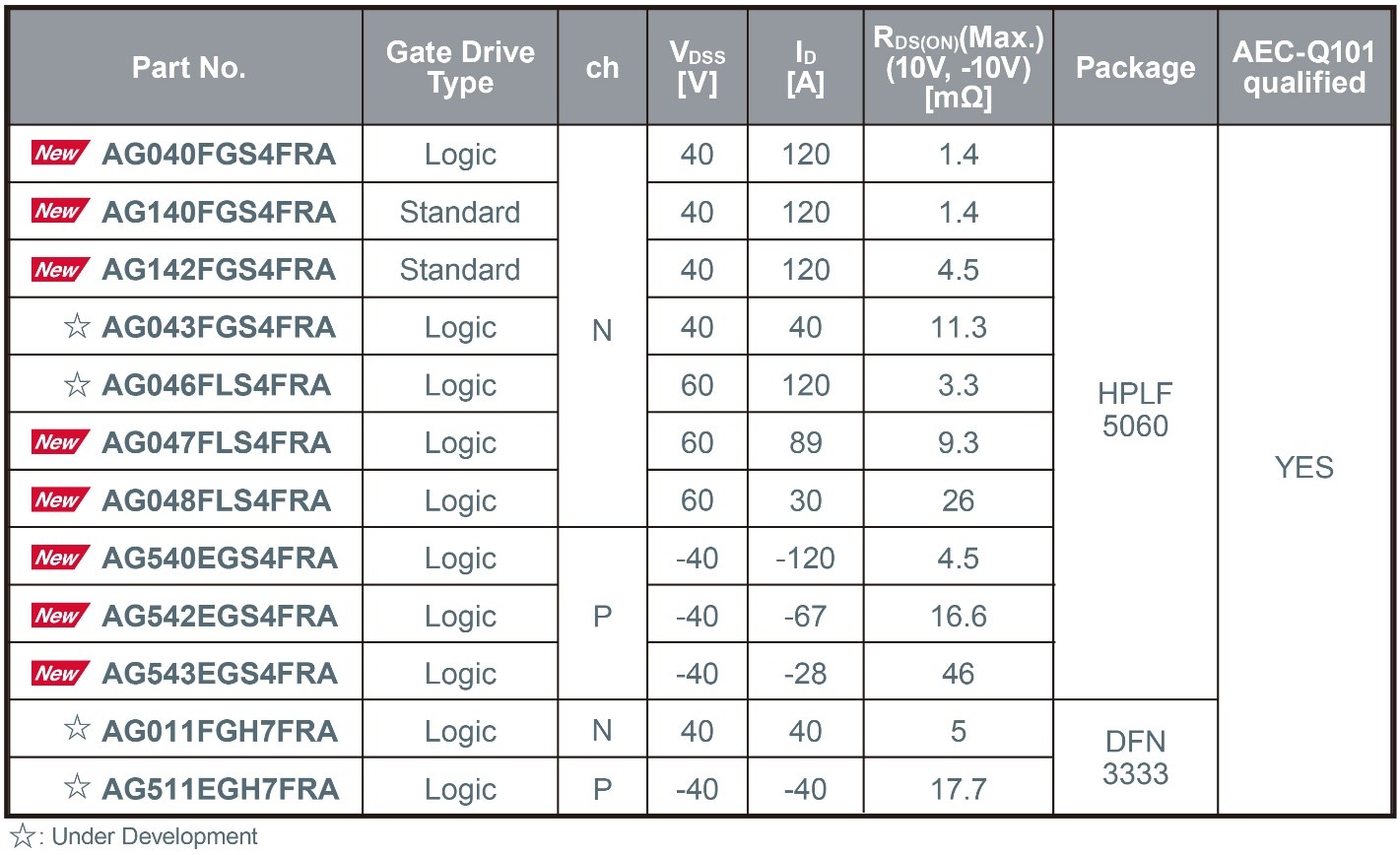
ROHM has expanded its lineup of low-voltage (40V/60V) MOSFETs for automotive applications – such as main inverter control circuits, electric pumps, and LED headlights – by introducing the latest products adopting the new HPLF5060 package (4.9mm × 6.0mm).
In recent years, automotive low-voltage MOSFETs have been trending toward smaller packages, such as the 5060-size and even more compact options. However, this miniaturisation introduces significant challenges for achieving reliable mounting, primarily due to narrow terminal spacing and leadless designs.
To address these issues, the new HPLF5060 package offers a smaller footprint compared to the widely used TO-252 package (6.6mm × 10.0mm) while enhancing board-mount reliability through the adoption of gull-wing leads. Additionally, the use of copper clip junction technology enables high-current operation, making the HPLF5060 an ideal solution for demanding automotive environments.
Mass production of new products using this package began in November 2025 (sample price: $3.5/unit, excluding tax). Online sales have also started, and the products are also available for online purchase through online distributors such as DigiKey and Farnell.
In addition to expanding the lineup of products using this package, mass production of the smaller DFN3333 (3.3mm × 3.3mm) package, which employs wettable flank technology, is scheduled to begin around February 2026. Furthermore, development has commenced on a TOLG (TO-Leaded with Gull-wing) package (9.9mm × 11.7mm) to further expand the lineup of high-power, high-reliability packages.
The post ROHM’s New Compact, Highly Reliable Package Added to Automotive 40V/60V MOSFET Lineup appeared first on ELE Times.
Fraunhofer ISE achieves record efficiencies for tandem photovoltaic modules
AI in 2026: Enabling smarter, more responsive systems at the edge

As artificial intelligence (AI) continues its momentum across the electronics ecosystem, 2026 is shaping up to be a defining year for edge AI. After years of rapid advancement in cloud‑centric AI training and inference, the industry is reaching a tipping point. High‑performance intelligence is increasingly migrating to the edge of networks and into systems that must operate under stringent constraints on latency, power, connectivity, and cost.
This shift is not incremental. It reflects a broader architectural evolution in how engineers design distributed intelligence into next‑generation products, systems, and infrastructure.
Consider an application such as detecting dangerous arc faults in high‑energy electrical switches, particularly in indoor circuit breakers used in residential, commercial, or industrial environments. The challenge in detecting potential arc faults quickly enough to trip a breaker and prevent a fire hazard is that traditional threshold‑based criteria often generate an impractically high number of false positives, especially in electrically noisy environments.
An AI‑based trigger‑detection approach can significantly reduce false positives while maintaining a low rate of false negatives, delivering a more practical and effective safety system that ultimately saves lives.
What edge AI means for design
Edge AI refers to artificial intelligence processing performed on or near the physical hardware that collects and acts on data, rather than relying solely on remote cloud data centers. By embedding inference closer to where data originates, designers unlock real‑time responsiveness, tighter privacy controls, and reduced dependence on continuous network connectivity.
These capabilities allow systems to make decisions in milliseconds rather than seconds, a requirement across many industrial and embedded domains.

Figure 1 Smart factory environments demand immediate pattern recognition and decision‑making.
From factory automation to safety‑critical monitoring, the need for immediate pattern recognition and decision‑making has become a core design constraint. Systems must be engineered to operate with local intelligence that is context‑aware and resilient, maintaining performance even during intermittent or unavailable cloud connectivity.
Engineering drivers behind the edge shift
Design engineers are responding to several overlapping trends.
- Latency and determinism
Latency remains a fundamental limiter in real‑time systems. When AI models execute at the edge instead of in the cloud, network round‑trip delays are eliminated. For applications such as command recognition, real‑time anomaly detection, and precision control loops, deterministic timing is no longer optional—it is a design requirement.

Figure 2 Latency issues are driving many industrial applications toward edge AI adoption.
In the arc‑fault detection example described earlier, both latency and determinism are clearly essential in a safety‑oriented system. However, similar constraints apply to other domains. Consider an audio‑based human‑machine interface for an assistive robot or a gesture‑based interface at an airport kiosk. If system response is delayed or inconsistent, the user experience quickly degrades. In such cases, local, on‑device inference is critical to product success.
- Power and energy constraints
Embedded platforms frequently operate under strict power and energy constraints. Delivering AI inference within a fixed energy envelope requires careful balancing of compute throughput, algorithm efficiency, and hardware selection. Engineering decisions must support sustained, efficient operation while staying within the electrical and packaging limits common in distributed systems.
- Data privacy and security
Processing AI locally reduces the volume of sensitive information transmitted across networks, addressing significant privacy and security concerns. For systems collecting personal, operational, or safety‑critical data, on‑device inference enables designers to minimize external exposure while still delivering actionable insights.
For example, an occupancy sensor capable of detecting and counting the number of people in hotel rooms, conference spaces, or restaurants could enable valuable operational analytics. However, even the possibility of compromised personal privacy could make such a solution unacceptable. A contained, on‑device system becomes essential to making the application viable.
- Resource efficiency and scalability
In deployments involving thousands or millions of endpoints, the cumulative cost of transmitting raw data to the cloud and performing centralized inference can be substantial. Edge AI mitigates this burden by filtering, transforming, and acting on data locally, transmitting only essential summaries or alerts to centralized systems.
Edge AI applications driving design innovation
Across industries, edge AI is moving beyond pilot programs into full production deployments that are reshaping traditional design workflows.
Industrial systems
Predictive maintenance and anomaly detection now occur directly at the machine, reducing unplanned downtime and enabling real‑time operational adjustments without dependence on remote analytics.

Figure 3 Edge AI facilitates predictive maintenance directly at the machine.
Automotive and transportation
In‑vehicle occupancy sensing is emerging as a critical edge AI application. Systems capable of detecting the presence of passengers—including children left in rear seats—must operate reliably and in real time without dependence on cloud connectivity.
On‑device AI enables continuous monitoring using vision, radar, or acoustic data while preserving privacy and ensuring deterministic system response. These designs prioritize safety, low power consumption, and secure local processing within the vehicle’s embedded architecture.
Consumer and IoT devices
Smart devices that interpret voice, gesture, and environmental context locally deliver seamless user experiences while preserving battery life and privacy.
Infrastructure and energy
Distributed assets in energy grids, utilities, and smart cities leverage local AI to balance loads, detect dangerous arc faults, and optimize performance without saturating communication networks. A common theme emerges across these sectors: the more immediate the required intelligence, the closer the AI must reside to the data source.
Design Considerations for 2026 and beyond
Embedding intelligence at the edge introduces new complexities. Beyond system design and deployment, AI development requires structured data collection and model training as both an initial and ongoing effort. Gathering sufficiently diverse and representative data for effective model training demands careful planning and iterative refinement—processes that differ from traditional embedded development workflows.
However, once structured data collection becomes part of the engineering lifecycle, many organizations find that it leads to more practical, cost‑effective, and impactful solutions.
Beyond data strategy, engineers must address tight memory footprints, heterogeneous compute architectures, and evolving toolchains that bridge model training with efficient, deployable inference implementations. A holistic approach requires profiling real‑world operating conditions, validating model behavior under constraint, and integrating AI workflows with existing embedded software and hardware stacks.
In this context, the selection of compute architecture and development ecosystem becomes critical. Platforms offering a broad performance range, robust security mechanisms, and long product lifecycles enable designers to balance immediate requirements with long‑term roadmap considerations. Integrated development flows that support optimization, profiling, and debugging across the edge continuum further accelerate time to market.
Edge AI in 2026 is not simply a buzz phrase—it’s a strategic design imperative for systems that must act quickly, operate reliably under constraint, and deliver differentiated performance without overburdening networks or centralized infrastructure.
By bringing intelligence closer to where data is generated, engineers are redefining what distributed systems can achieve and establishing a new baseline for responsive, efficient, and secure operation across industries.
Nilam Ruparelia is associate director of Microchip’s Edge AI business unit.
Special Section: AI Design
- The AI design world in 2026: What you need to know
- AI workloads demand smarter SoC interconnect design
- AI’s insatiable appetite for memory
- The AI-tuned DRAM solutions for edge AI workloads
- Designing edge AI for industrial applications
- Round pegs, square holes: Why GPGPUs are an architectural mismatch for modern LLMs
- Bridging the gap: Being an AI developer in a firmware world
- Why power delivery is becoming the limiting factor for AI
- Silicon coupled with open development platforms drives context-aware edge AI
- Designing energy-efficient AI chips: Why power must Be an early design consideration
- Edge AI in a DRAM shortage: Doing more with less
The post AI in 2026: Enabling smarter, more responsive systems at the edge appeared first on EDN.
The Rise of the AgentEngineer: How AI is Orchestrating the Future of Chip Design
While traditional Electronic Design Automation tools have been faithfully executing commands for decades, today’s agentic AI systems are rewriting the rulebook by thinking, iterating, and problem-solving autonomously across entire design workflows. Picture this: specialised AI agents functioning like a virtual design team—complete with their own CEO, CTO, and engineering specialists—orchestrating everything from RTL generation to physical design verification in feedback-driven loops that don’t just respond to errors, they anticipate and resolve them. This isn’t your standard chatbot-writes-some-code scenario; we’re talking about multi-agent architectures powered by Large Language Models that refuse to call it a day until every simulation passes. As the semiconductor industry grapples with a workforce crisis that threatens to bottleneck innovation, these AI systems are emerging as more than assistants; they’re becoming co-designers capable of exponentially multiplying engineering productivity. To understand how industry leaders are navigating this transformation from AI-assisted to AI-orchestrated design, we reached out to companies at the forefront of this revolution.
Architecture to Autonomy: Building Multi-Agent AI Systems for Chip Design
The semiconductor design floor is witnessing an unprecedented transformation where intelligent agents collaborate, critique, and refine work autonomously, like a seasoned design team operating at machine speed.
The Multi-Agent Architecture
Industry implementations structure these systems around specialised agent roles: RTL generation specialists handle code synthesis, verification agents scrutinise design correctness, and physical design agents optimise layouts. The orchestration framework manages task routing and dependencies, ensuring coherent workflow progression. Critically, these agents don’t replace existing EDA platforms; instead, they orchestrate them, invoking synthesis runs and analysing timing reports with minimal human intervention.
LLM Selection and Domain Adaptation
Behind these agents run Large Language Models serving as inference engines. The industry has split between proprietary models like GPT-4 and Claude, which offer robust reasoning capabilities, and open-source alternatives such as DeepSeek-Coder and Llama variants, providing customisation flexibility for high-volume workloads.
Raw LLMs produce generic code, but semiconductor design demands precision. Organisations implement two adaptation strategies: Retrieval-Augmented Generation (RAG) connects LLMs to design rule manuals, timing libraries, and verified IP repositories, grounding outputs in proven patterns. Domain-specific fine-tuning retrains models on millions of lines of verified RTL, enabling them to recognise design intent from terse specifications and suggest synthesis-aligned optimisations.
Talking about choosing the “right” LLM, 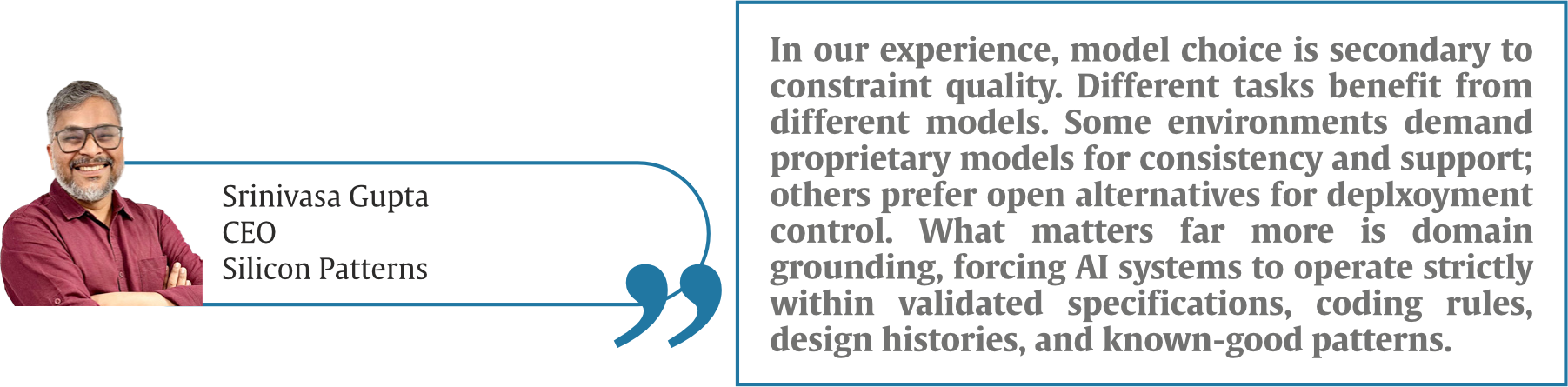
Addressing Code Hallucination
The critical challenge remains code hallucination, plausible but incorrect outputs. Industry leaders deploy multi-layered validation: formal verification integration, simulation-in-the-loop refinement cycles, constraint-guided generation, and mandatory human review checkpoints for critical path logic. As one verification lead noted, AI-generated RTL receives the same scrutiny as junior engineer code, but iterates at 100x speed before human review.
“Hallucination is not a mysterious AI problem. It is the result of under-specified intent. We deal with it the same way we deal with junior engineers: through validation gates. Every AI-generated output passes through linting, simulation, coverage analysis, and equivalence checks. Nothing bypasses human review for critical design decisions. Trustworthy output comes from engineering discipline applied to AI, not from believing AI will magically become trustworthy,” added Gupta.
The technical architecture is maturing rapidly, but the true test ahead is scaling from engineer assistance to autonomous subsystem design, determining whether agentic AI becomes indispensable infrastructure or remains an expensive experiment.
AgentEngineer Revolution: Transforming Roles and Multiplying Productivity
The automation wave reshaping semiconductor design isn’t just changing workflows—it’s fundamentally redefining what it means to be a design engineer in 2026.
Quantifiable Productivity GainsEarly adopters report transformative productivity metrics. RTL generation rates have surged from approximately 50-100 lines per engineer-day in manual workflows to 500-1,000+ lines with AI assistance—a 10x improvement when measured by functional complexity rather than raw line count. Time-to-tapeout reductions range from 20-40% for complex SoC projects, with verification cycles seeing the most dramatic compression.
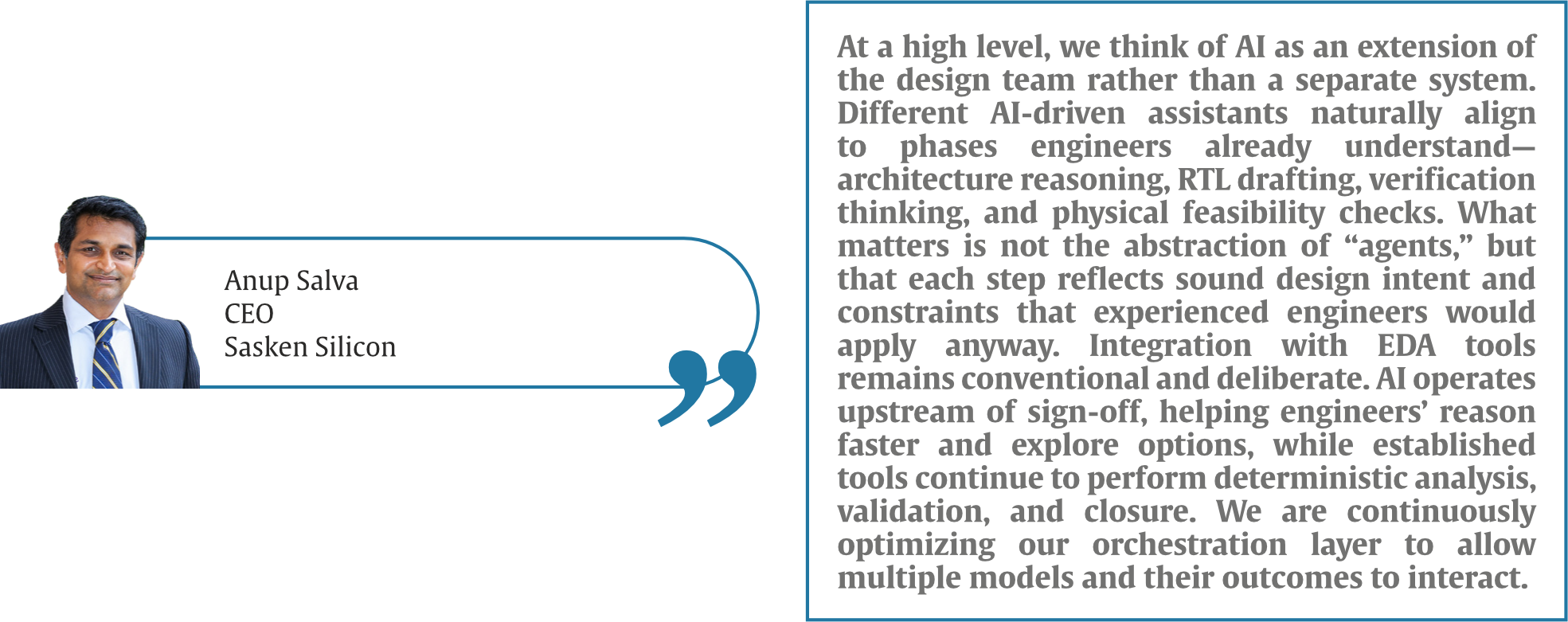
“The biggest gains have come from reducing friction, not replacing engineers. Tasks that previously required multiple iteration initial RTL structure, verification scaffolding, and early debug hypotheses now converge faster. We typically see meaningful schedule compression in early and mid-design phases, allowing teams to spend more time on optimisation, corner cases, and RF-digital interactions. This has increased our capacity to take on more complex mixed-signal and SoC programs without sacrificing rigour,” explains Anup Salva, CEO, Sasken Silicon.
Verification coverage metrics tell an equally compelling story. AI-driven testbench generation achieves 85-95% functional coverage in initial passes compared to 60-70% with manual approaches, while bug detection rates during pre-silicon validation have improved by 30-50%. One design team reported identifying critical corner-case failures that traditional directed tests missed entirely, caught by AI agents exploring unconventional stimulus patterns.
Perhaps most significant: engineering teams report handling 2-3x more concurrent design projects without proportional headcount increases, effectively multiplying organisational capacity during an industry-wide talent shortage.
The Evolving Engineer RoleThe shift from manual RTL coding to AI-orchestrated design is forcing a fundamental role transformation. Traditional design engineers spent 60-70% of their time writing and debugging code. Today’s “AgentEngineers” allocate that time differently: 40% on high-level architectural specification and constraint definition, 30% on AI output validation and refinement, 20% on system integration and optimisation, and just 10% on direct coding for critical path logic AI cannot yet handle reliably.
Talking on the evolving role of Engineers in the AI era, Srinivas Gupta, CEO, Silicon Patterns, emphasises that, “AI is not eliminating engineering roles, it is exposing who is adding real value. The role of the engineer is shifting from manual construction to intent definition, supervision, and judgment. Writing RTL is no longer the bottleneck; understanding what should be written and why is. Effective training is not about teaching “prompt engineering.” It is about teaching engineers how to reason clearly, review outputs critically, and understand failure modes. The best learning happens when AI is embedded directly into real project workflows, spec reviews, verification bring-up, debug, not in isolation.”
New competencies are emerging as essential: prompt engineering skills to communicate design intent effectively to LLM agents, AI system supervision capabilities to recognize when autonomous agents are diverging from design goals, and elevated architectural thinking to work at higher abstraction layers. The most successful engineers are those who transition from implementation experts to design orchestrators—defining what to build while delegating how to build it.
Training for TransformationOrganisations are implementing structured transition programs. Technical training covers AI model capabilities and limitations, effective prompt crafting for design specifications, and verification strategies for AI-generated code. Just as importantly, cultural training addresses the psychological shift from individual contributor to AI collaborator, teaching engineers when to trust autonomous outputs and when human judgment remains irreplaceable.
The semiconductor workforce crisis that threatened industry growth is being addressed not through massive hiring campaigns, but through radical productivity multiplication—a smaller cohort of AgentEngineers accomplishing what previously required entire design teams.
Trust, Validation, and the Road to 2026: Overcoming Deployment Challenges
Agentic AI’s technical promise confronts harsh deployment realities. The path from laboratory demonstration to production tapeout demands solving trust, integration, and scalability challenges that determine whether this technology revolutionises the industry or remains confined to pilot projects.
The Three Critical Deployment ChallengesIntegration Complexity tops the challenge list. Legacy EDA environments weren’t architected for AI orchestration—tool licenses limit concurrent sessions, APIs lack programmatic access depth, and design databases struggle with AI agents’ iterative read/write intensity. Organisations report 6-12 month integration timelines just to achieve basic agent-tool interoperability.
Trust and Validation Frameworks represent the existential challenge. For tape-out critical stages—final timing closure, DFT insertion, physical verification—engineers demand confidence levels AI systems cannot yet guarantee. One design director noted, “We can’t ship silicon that passes simulation but fails in production because an AI agent hallucinated a clock domain crossing fix.”
Organisational Resistance manifests subtly but persistently. Experienced engineers trained over decades resist delegating design authority to probabilistic systems. Version control becomes contentious when distinguishing human versus AI contributions. Accountability questions arise when AI-generated blocks cause post-silicon failures.
Building Trust Through ValidationSuccessful deployments implement rigorous validation hierarchies. AI-generated RTL undergoes formal equivalence checking against specifications, simulation coverage thresholds exceed 95% before human review, and critical paths receive mandatory expert sign-off regardless of AI confidence scores. Human-in-the-loop checkpoints gate progression, with engineers retaining veto authority at every stage.
Observability tools provide transparency into AI decision-making—logging which training examples influenced specific design choices, tracking confidence metrics for generated code segments, and flagging low-confidence outputs for immediate human review.
The 2026 Automation RoadmapIndustry consensus positions current systems at Level 2 on the five-level autonomy scale: capable assistants requiring continuous supervision. Reaching Level 4—autonomous subsystem design with minimal oversight—demands breakthroughs across multiple fronts.
Enhanced LLM reasoning must progress beyond pattern matching to genuine architectural trade-off analysis, understanding power-performance-area implications of micro-architectural choices. Memory systems need expansion to manage entire SoC contexts rather than isolated module designs. Formal methods integration must advance from post-generation validation to constraint-guided generation, preventing invalid designs rather than detecting them.
On the India front, Anup Salva, CEO, Sasken Silicon, notes that, “India’s advantage lies in its depth of engineering intuition, especially in areas like RF, analogue, and system-level integration. These are domains where AI works best as a multiplier, not a replacement. Over the next few years, we expect higher automation in well-understood design spaces, but always guided by engineers who understand the underlying physics and architecture. Progress will be driven more by better problem formulation and design discipline than by radical new tools.”
The competitive landscape trajectory appears clear: by late 2026, agentic AI will likely transition from a competitive differentiator to table stakes. Organisations not deploying these systems risk falling behind on time-to-market metrics. Yet the dominant paradigm will remain hybrid human-AI workflows rather than full autonomy—engineers orchestrating AI agents rather than being replaced by them, at least through this decade.
by: Shreya Bansal, Sub-Editor
The post The Rise of the AgentEngineer: How AI is Orchestrating the Future of Chip Design appeared first on ELE Times.
I love my teacher
 | submitted by /u/RequiemOfLigh [link] [comments] |
USB Hub made entirely of TH components
 | Didnt think it was a thing! Would have expected some mandatory SMT ICs [link] [comments] |
Сторінки




![[link]](https://i.redd.it/obio4jbi06kg1.jpeg)
![[link]](https://i.redd.it/4z6i7vs104kg1.jpeg)