


Збирач потоків
ST Foundation Continues Expansion of Digital Literacy Initiatives in India; Honours IFCCI ‘CSR Project of the Year’ Recognition
The ST Foundation, the non-profit corporate arm of STMicroelectronics, hosted a media briefing late January 2026 to outline its strategic expansion in India and celebrate the recent recognition of its flagship “Digital Unify” program. Dedicated to bridging the global digital divide since 2001. The Foundation’s mission has taken on critical urgency in India, where over 400 million people remain excluded from essential digital services.
Addressing the 400 Million Divide
With global data from the 2025 ITU Connectivity Report indicating that 2.2 billion people lack basic digital access, the ST Foundation has positioned India as a central focus for its “Digital Unify” (DU) initiative. The program uses a “train-the-trainer” model and local partnerships to ensure sustainable, community-owned growth.
Impact in Asia and India
In Asia alone, the foundation has 96 Digital Unify Labs, serving about 26,000 beneficiaries per year at a cost of less than $10 per student trained.
The Foundation in India was officially registered in 2018, having reached more than 180,000 trainees to date and having established over 56 Digital Unify Labs across the country.
Key Program Impact and Expansions:
- Education for Vulnerable Children: Since 2022, the “Basic Coding” program has reached over 2,500 children aged 9–13 in slum areas, providing many with their first-ever exposure to digital devices.
- Rehabilitation for Incarcerated Individuals: In partnership with the India Vision Foundation, the “Introduction to Computer Basics” (ICB) course has trained over 3,300 incarcerated people across Uttar Pradesh and Delhi (including Central Jail Rohini) to aid in their eventual reintegration into society.
- Empowering the Visually Impaired: A specialised ICB4VI pilot recently trained 17 visually impaired girls in digital skills. The Foundation is now preparing to scale this model nationwide.
Digital Unification and Cyber Concerns
The Foundation has not only been providing underprivileged people with digital literacy but has also helped them with understanding the basic risks of cyber-attacks, briefings on cybersecurity and internet safety.
Award-Winning Impact
The briefing also highlighted the Foundation’s recent accolade as the “CSR Project of the Year” at the 7th Indo-French Chamber of Commerce & Industry (IFCCI) CSR Conclave & Awards. This award recognises the program’s effectiveness in turning the digital access gap into tangible opportunities for education and employment.
By: Shreya Bansal, Sub-Editor
The post ST Foundation Continues Expansion of Digital Literacy Initiatives in India; Honours IFCCI ‘CSR Project of the Year’ Recognition appeared first on ELE Times.
R&S drives connections and innovations at MWC Barcelona 2026
Rohde & Schwarz will exhibit its extensive portfolio of next generation of wireless technologies, under the motto, “Enabling Connections, Empowering Innovations”, at the Mobile World Congress 2026 in Barcelona, Fira Gran Via, hall 5, booth 5A80 from March 2 to 5, 2026.
The path from 5G to 6G
For a seamless evolution from 5G to 6G, Rohde & Schwarz offers future-ready test solutions for mobile devices and networks. Among the many innovative solutions, the CMX500 one-box signalling tester stands out throughout multiple demos, addressing today’s and tomorrow’s testing challenges.
- Paving the way for 6G, Rohde & Schwarz showcases carrier aggregation combining FR1 and FR3 frequency ranges with its CMX500 one-box signalling tester. The demonstration validates end-to-end device behaviour across the aggregated spectrum. FR3 (7.125 to 24.25 GHz) has been identified by industry and research as a “sweet spot” for combining wide-area coverage with high capacity. Equipped with the new, upgradeable RFU18 board for the CMX500, the tester covers up to 18 GHz, giving users enough headroom for FR3 evolution and a future-ready path for testing next-generation networks.
- Another setup addresses virtual signalling testing. Based on the CMX500, Rohde & Schwarz demonstrates a new approach of shift-left testing, allowing R&D engineers to find design flaws early in their mobile radio modem chips before costly silicon fabrication. This early SDR-based validation will significantly cut time-to-market for 6G devices.
- Ray tracing simulates real-world signal propagation environments, making it a valuable technique for AI receiver testing for future 6G devices. Rohde & Schwarz will showcase the CMX500 as it creates a digital twin of signal propagation within its test environment by leveraging the VIAVI
 ray tracing engine. This enables controlled and reproducible validation of complex scenarios with high measurement precision, facilitating site-specific optimisation of radio links and reducing the need for tedious field tests.
 - Rohde & Schwarz also advances 5G and emerging 6G testing with its AI-based toolset AI Workplace for the CMX500, massively enhancing testing productivity. TechAssist uses natural language to control the CMX500, enabling rapid test-scenario setup and status/configuration queries, while an upgraded ScriptAssist with a new interface simplifies and accelerates scripting for R&D protocol and application testing as well as instrument automation. Visitors can experience these AI-powered tools in action within various setups at MWC 2026.
- Mobile XR and personal AI devices like smart glasses and wearables are key for 5G-Advanced and 6G-enabled immersive 3D communications. Delivering compelling, low-latency experiences will require rigorous, realistic testing. Rohde & Schwarz will demonstrate an end-to-end testbed centred around the CMX500, addressing AI on RAN and XR testing challenges with its ability to emulate 4G, 5G and Wi-Fi networks, applying both RF and IP impairments to reproduce real-world conditions such as interference and congestion.
- 6G ISAC (Integrated Sensing and Communication), which leverages mobile networks for object detection, is rapidly gaining traction. Rohde & Schwarz will demonstrate new capabilities of its R&S AREG800A, including the emulation of micro-Doppler signatures – in addition to distance, speed and RCS – to support object classification, such as drones.
- For testing base stations and network infrastructure, Rohde & Schwarz showcases the PVT360. It meets the requirements for testing FR1/FR2, small cells and O-RU in a single box. For the verification of frequency converting antennas used in SATCOM, NTN or 5G and 6G applications, visitors can learn about CATR-based over-the-air test chambers, enabling fast OTA-testing of phased antenna arrays.
- With the first off-the-shelf commercial mobile devices now available for 5G broadcast, Rohde & Schwarz lets visitors explore seamless rich data distribution transmission to mobile devices, innovative applications like venue casting, emergency alerts and advanced solutions for terrestrial positioning, navigation and timing.
From ground to orbit with NTN
As terrestrial and satellite-based networks converge, it becomes increasingly complex to simulate real-world conditions while meeting 3GPP requirements, for instance, when it comes to handovers within orbits, between orbits or from space to ground. As NTN technology matures alongside 5G and towards 6G, overcoming significant technical hurdles is key to realising NTN’s potential.
- Rohde & Schwarz has upgraded its CMX500 one-box signalling tester, supporting NR-NTN, NB-NTN and Direct-to-Cell (D2C/DTC) technologies in a single platform. The tester creates a digital twin of the sky, simulating orbits, bands and impairments like Doppler shifts and fading. Combined with smart features like the Constellation Insights Tool, it allows engineers to visualise satellite constellations, analyse coverage gaps and observe trajectories.
- Rohde & Schwarz also supports NTN conformance and carrier acceptance testing, offering the highest number of validated test cases for NR-NTN according to 3GPP Rel.17. In cooperation with Samsung, validations were conducted across all three test domains: RF, RRM and PCT. At MWC 2026, visitors will not only be able to experience these test cases but also see a demonstration of Viasat’s test plan for NB-NTN, covering protocol, performance and RF test scenarios.
Industry collaborations to accelerate AI-RAN
AI is becoming an integral part of the RAN, enabling performance optimisation, improved energy efficiency and more autonomous operations. As a member of the AI-RAN Alliance, Rohde & Schwarz continues industry collaboration and provides reliable test equipment for navigating interoperability in this evolving landscape.
- Rohde & Schwarz and Nokia Bell Labs have collaborated on an AI/ML-based 6G base station radio receiver employing Digital Post Distortion (DPoD) to recover distorted uplink signals. DPoD improves link budget, preserves coverage and reduces the need for dense site deployments, lowering costs. DPoD also reduces mobile device complexity and power consumption. The testbed at the Rohde & Schwarz booth, comprising the R&S SMW200A vector signal generator and the newly launched FSWX signal and spectrum analyzer will showcase the improved performance of Nokia’s AI receiver for uplink signals with different distortion levels.
- In collaboration with NVIDIA, Rohde & Schwarz will exhibit its latest proof-of-concept, also leveraging digital twin technology and high-fidelity ray tracing. This approach creates a robust framework for testing AI-enhanced base stations for both 5G-Advanced and 6G under realistic propagation conditions. This integration aims to bridge the gap between AI-driven wireless simulations and real-world deployment, facilitating more efficient and accurate testing of next-generation receiver architectures.
Next-generation Wi-Fi experience
Wi-Fi 8 sets new expectations for consistent, ultra-high-reliability and quality connectivity. Designed to handle a growing number of connected devices and demanding applications like XR or industrial IoT, IEEE 802.11bn employs ever more complex MIMO (Multiple-Input, Multiple-Output) scenarios. Rohde & Schwarz enables manufacturers with its solution portfolio, from R&D to production.
- The CMX500 one-box signalling tester is now equipped with comprehensive Wi-Fi 8 capabilities. The tester’s flexibility and embedded IP test capabilities make it a versatile solution for a broad range of Wi-Fi 8-specific tests, such as dRu (distributed resource unit), introducing distributed resource allocation, and UEQM (unequal modulation) where different MIMO layers use different modulation schemes, as well as 320 MHz channel bandwidth.
- To navigate the technical complexities of Wi-Fi 8 throughout the entire device lifecycle – from development to production – Rohde & Schwarz will exhibit the CMP180 radio communication tester, designed for testing in non-signalling mode with advanced capabilities and broad bandwidth support. The CMP180 combines two analysers and generators for efficient testing of 2×2 MIMO Wi-Fi 8 devices.
- For high-end MIMO signal generation and analysis tasks in R&D, Rohde & Schwarz will display the R&S SMW200A vector signal generator and the newly launched FSWX signal and spectrum analyser. With its outstanding standard EVM performance and in combination with its cross-correlation feature, the FSWX discovers details of Wi-Fi 8 signals that have been hidden up to now and offers new margins for optimisation. Its multichannel architecture makes the FSWX well-suited for analysing complex scenarios like multi-user MIMO (MU-MIMO).
Automotive connectivity testing
Vehicle manufacturers are integrating increasing levels of wireless connectivity to enable new user experiences, safety features and higher levels of autonomous driving. Rohde & Schwarz offers precise test solutions that cover all wireless technologies used in the automotive industry, from 5G and ultra-wideband to C-V2X and GNSS.
- With NG eCall becoming mandatory for vehicles sold in Europe starting in 2026, Rohde & Schwarz will demonstrate compliance testing capabilities using the CMX500 one-box signalling tester and R&S SMBV100B vector signal generator. The test solution also supports the upcoming Chinese automotive GNSS test standard, GB/T 45086.1 2024, expected to be mandatory for the Automotive Emergency Call System in 2027, with automated testing.
- Non-terrestrial networks have the potential to provide ubiquitous automotive connectivity and require enhancements to key components such as the chipsets, TCU and antennas. Trade show visitors can discover at MWC 2026 how the company’s comprehensive NTN test solutions can help the automotive industry create the always-connected vehicle.
Solutions for mission-critical communications and spectrum monitoring
Mission-critical communications (MCX) support public safety, first responders and emergency services by providing extremely reliable, low-latency and secure communications even in adverse conditions. Rohde & Schwarz will showcase its integrated solutions for testing devices and mobile networks, facilitating the ongoing migration to 3GPP-compliant broadband mission-critical services.
- The QualiPoc platform will be demonstrated with new capabilities for MCX testing. This smartphone-based solution allows detailed performance assessment of MCX private and group calls, including measurement of 3GPP-defined MCX KPIs. New features include direct MCX app control and the ability to measure quality of service (QoS) and quality of experience (QoE) for public safety communications. The R&S LCM, an autonomous monitoring probe, and the R&S TSMS8, the fastest network scanner, will also be on display, further expanding capabilities for both business and mission-critical networks.
- Rohde & Schwarz will also exhibit a protocol conformance test solution to verify that MCX devices and client software implementations adhere to 3GPP specifications.
- Expanding its spectrum monitoring portfolio, Rohde & Schwarz will launch two new products at MWC Barcelona 2026: These solutions will enable regulatory authorities, network operators and public services in over 100 countries to actively protect the electromagnetic spectrum and address evolving monitoring challenges. The new devices will enhance capabilities in interference hunting and regulatory compliance.
Endpoint security, network visibility and secure network solutions
Robust security solutions deliver seamless and reliable communications experiences. Rohde & Schwarz subsidiaries will also present their innovative solutions supporting the wireless ecosystem.
- The Rohde & Schwarz Networks & Cybersecurity division, comprising the subsidiaries Rohde & Schwarz Cybersecurity and LANCOM Systems, provides endpoint security, secure networks and high-quality cryptography. With products “Engineered in Germany”, they ensure trustworthy, reliable and secure data transfer, specialising in the public, critical infrastructures, defence, health, retail and SME verticals. At MWC 2026, Rohde & Schwarz Cybersecurity will showcase the Layer 2 encryptor R&S SITLine ETH NG and the R&S ComSec solution enabling secure mobile working with sensitive data on iPhones and iPads. LANCOM Systems will present an overview of its Wi-Fi 7 access point portfolio, the latest 5G router models and firewalls.
- As networks become more distributed, encrypted and dynamic, network visibility becomes indispensable. At the Rohde & Schwarz booth, visitors will experience how the ready-to-deploy, DPI-powered R&S Probe Observer delivers deep network visibility, precise real-time traffic analytics and actionable intelligence. Developed by ipoque, a Rohde & Schwarz company, this deep packet inspection (DPI) software probe analyses network traffic at the application level, enabling operators to understand, optimise, and control their networks while supporting faster detection, diagnosis and resolution of network and service issues.
Rohde & Schwarz will showcase its comprehensive portfolio of test and measurement and industry solutions at Mobile World Congress 2026 at Fira Gran Via in Barcelona, in hall 5, booth 5A80. Trade magazine editors and press representatives visiting the event are invited to schedule briefings with their press contact at Rohde & Schwarz.
The post R&S drives connections and innovations at MWC Barcelona 2026 appeared first on ELE Times.
EVs, Software and the Grid: Why the Real EV Challenge Is Infrastructure, Not Vehicles
Speaking at the Auto EV Tech Vision Summit 2025, Mohammadsaeed Mombasawala laid bare a reality the EV industry often skirts around—electric vehicles are evolving fast, but the ecosystem supporting them is dangerously lagging.
Opening his address with a provocative question—“Is EV done and dusted?”—Mombasawala was quick to answer it himself: far from it. Innovation in EVs is accelerating, but the real battleground is no longer the vehicle alone. It is charging infrastructure, grid readiness, and software-defined architectures that will decide the success or failure of the transition.
Charging Anxiety Will Not Be Solved with AC
According to Mombasawala, EV charging anxiety cannot be addressed with slow, AC charging solutions. The industry is inevitably moving towards high-power DC fast charging, with capacities of 50 kW and above becoming the new norm.
But charging speed alone is not enough. He highlighted the emergence of plug-and-play charging, where vehicles authenticate themselves automatically through preloaded scripts and cloud connectivity—eliminating the need for RFID cards or manual authentication. In this model, the vehicle communicates with the charger via the cloud, pre-authorises itself, and begins charging seamlessly, reflecting the deeper convergence between EVs and software-defined vehicles (SDVs).
Vehicle-to-Grid: Opportunity Born from Crisis
One of the most critical trends Mombasawala pointed to was Vehicle-to-Grid (V2G) —using EVs not just as consumers of electricity, but as mobile energy sources capable of feeding power back into the grid.
This, he explained, is not just a technological curiosity, but a necessity born from a looming crisis. “I have done the calculation myself,” he noted. If all vehicles in Delhi were replaced with EVs and charged using 50 kW fast chargers, the grid would require 7,000 MW of additional power just to charge vehicles within 5–8 minutes. No grid today is prepared for that kind of load”.
The implication is stark: while EV adoption is racing ahead, grid infrastructure is nowhere close to ready.
The Grid Is the Real Bottleneck
Mombasawala warned that without serious innovation and investment in electrical infrastructure, a rapid EV transition could destabilise the power system itself.
“If we transition the whole country by 2030 at this pace, the grid will collapse,” he cautioned. The issue is no longer just EV range anxiety—it is national power security. Without infrastructure upgrades, consumers may find themselves unable to charge vehicles and facing power shortages at home.
Electrical engineers, he stressed, have a monumental role ahead—not just in vehicles, but in re-architecting the grid to handle electrified mobility at scale.
Software-Defined Vehicles: Complexity Beneath the Surface
While SDVs are often discussed as sleek, updatable platforms, Mombasawala highlighted the hidden complexity beneath the headlines. Today’s vehicles contain hundreds of ECUs communicating through multiple discrete protocols. The industry urgently needs standardisation, moving towards Ethernet-based architectures to manage growing data and control demands.
He also pointed to emerging semiconductor trends such as chiplets, where optics and semiconductors are packaged together in a single die—underscoring how vehicle electronics are becoming more sophisticated and tightly integrated.
Why the Cloud Is Non-Negotiable
A recurring theme in his address was the absolute necessity of cloud backends for SDVs. With millions of vehicles requiring continuous updates, feature upgrades, and service enhancements, localised solutions are no longer viable. “There is no red reset button,” he reminded the audience. Without cloud-based services, upgrading and managing vehicle software at scale becomes impossible.
AI, Data Centres and the Limits of In-Vehicle Intelligence
One of the most sobering insights came from Mombasawala’s discussion on AI in SDVs. Advanced vehicle functions—braking behaviour, acceleration profiles, comfort tuning—will increasingly rely on AI models trained on massive datasets. But these models cannot be trained inside vehicles.
To put scale into perspective, he cited how companies like Meta use around 600,000 GPUs, while Elon Musk’s Grok reportedly uses 800,000 GPUs in a single data centre. Even with such resources, training models can take weeks. Training safety-critical vehicle systems like braking could require 6–8 weeks per iteration, and continuous retraining as new data arrives.
This underscores a key reality: SDVs are as much a data-centre problem as they are an automotive one.
Beyond the Hype
Mombasawala concluded by grounding expectations around SDVs. While the stories sound exciting, real-world vehicle control systems only stabilise through negative feedback loops, making their design and validation far more complex than popular narratives suggest. The EV transition, he implied, will not be won by flashy announcements alone. It will require deep engineering, infrastructure investment, and a sober understanding of system-level constraints.
As the industry pushes ahead, his message was clear: the future of EVs depends not just on better vehicles, but on grids, software, clouds, and engineers rising together.
The post EVs, Software and the Grid: Why the Real EV Challenge Is Infrastructure, Not Vehicles appeared first on ELE Times.
EEVblog 1733 - Mailbag: 2GHz Power Rail Probe, Retro Chip Tester
Redriver boosts automotive camera link reliability

Diodes’ PI2MEQX2505Q MIPI D-PHY ReDriver supports data rates up to 2.5 Gbps, making it well suited for ADAS and automotive camera monitoring systems. It provides one clock lane and four differential data lanes. Each data lane features programmable receiver equalization, output swing, and pre-emphasis, configurable via I²C or pin-strap. This helps optimize performance and reduce intersymbol interference across different physical media.

Compliant with MIPI D-PHY 1.2, the device regenerates D-PHY signals for CSI-2 and DSI interfaces over PCB traces, connectors, and cables. This extends trace lengths while minimizing power consumption and maintaining low latency. Activity-detection circuitry allows the redriver to enter a lower-power mode during Ultra-Low Power State (ULPS) and low-power (LP) states.
The PI2MEQX2505Q is AEC-Q100, Grade 2 qualified and operates from a 1.8 V supply over a temperature range of –40 °C to +105 °C. It comes in a compact 3.5 × 5.5 mm W-QFN3555-28/SWP package, supporting high-density channel routing.
Available now, the PI2MEQX2505Q is priced at $0.88 each in lots of 3500 units.
The post Redriver boosts automotive camera link reliability appeared first on EDN.
R&S expands mid-range spectrum analysis to 44 GHz

R&S has launched the 44-GHz FPL1044 spectrum analyzer along with a 40-MHz real-time spectrum analysis (RTSA) option for the entire FPL family. With the RTSA option, the FPL1044 can perform real-time measurements across its full frequency range from 10 Hz to 44 GHz. According to R&S, the FPL1044 is the first mid-range spectrum analyzer capable of reaching 44 GHz, making high-frequency testing more accessible.

The FPL1044 is the only model in the FPL family to offer a DC coupling option, enabling analysis of very low-frequency signals starting at 10 Hz. This capability extends measurement coverage from near-DC through the Ka-band. Compact and lightweight, the analyzer occupies minimal bench space, while an optional battery pack allows for portable operation.
The 26.5-GHz to 44-GHz frequency range is particularly important for aerospace and defense applications, including satellite communications, radar, and radio navigation. In these environments, the FPL1044 supports system verification, production quality control, and on-site repair and maintenance of high-frequency components such as filters, amplifiers, and traveling-wave tubes.
Configure and request a quote for any FPL spectrum analyzer, including the FPL1044, using the product page link below.
The post R&S expands mid-range spectrum analysis to 44 GHz appeared first on EDN.
GaN transistor cuts losses and heat

EPC’s first Gen 7 eGaN power transistor, the 40-V EPC2366, delivers up to 3× better performance than equivalent silicon MOSFETs. Now entering mass production, the device features a typical RDS(ON) of 0.84 mΩ and an optimized RDS(ON) × QG figure of merit of 12.6 mΩ·nC. This enables the EPC2366 to reduce conduction and switching losses while improving thermal performance.

Designed for high-efficiency, high-density power systems, the EPC2366 is suitable for synchronous rectifiers, DC/DC converters, AI server power supplies, and motor drives. It is rated for a drain-to-source voltage (VDS) up to 40 V, transient voltages up to 48 V, and a continuous drain current (ID) of 88 A, with pulsed currents reaching 360 A.
To assist design-in and evaluation, the EPC90167 half-bridge development board integrates two EPC2366 transistors in a low-parasitic layout, with PWM drive signals and flexible input modes.
The EPC2366 comes in a compact 3.3×2.6-mm PQFN package and is priced at $1.56 each in quantities of 3000 units. The EPC90167 development board is available for $211.65 each.
The post GaN transistor cuts losses and heat appeared first on EDN.
High-density power module fits compact AI servers

Enabling higher power delivery within the same rack space, Microchip’s MCPF1525 power module delivers up to 25 A per device and can be stacked to 200 A. The module integrates a 16-VIN buck converter with programmable PMBus and I²C control, making it well suited for powering PCIe switches and high-compute MPU applications used in AI deployments.

With dimensions of approximately 6.8×7.65×3.82 mm, the MCPF1525’s vertical construction maximizes board space, providing up to a 40% reduction in board area compared to alternative solutions. For improved reliability, the device incorporates multiple diagnostic functions reported over PMBus, including overtemperature, overcurrent, and overvoltage protection to help prevent undetected faults.
Housed in a thermally enhanced package, the MCPF1525 supports a junction temperature range from −40°C to +125°C. An embedded EEPROM enables users to program the default power-up configuration.
The MCPF1525 is available now, priced at $12 each in 1000-unit quantities.
The post High-density power module fits compact AI servers appeared first on EDN.
Vishay shrinks inductors, keeps full performance

Four power inductors in 0806 and 1210 case sizes from Vishay offer improved performance for commercial and automotive applications. Compared to competing inductors with similar performance, the devices use considerably less board space—up to 64% smaller in 0806 and 11% smaller in 1210 packages. They also support higher operating temperatures, a wider range of inductance values, and lower DC resistance to enhance efficiency.

The commercial IHLL-0806AZ-1Z and IHLL-1210AB-1Z have terminals plated only on the bottom, enabling smaller land patterns for more compact board spacing. The automotive-grade IHLP-0806AB-5A and IHLP-1210ABEZ-5A feature terminals plated on the bottom and sides, allowing a solder fillet that strengthens the mount against mechanical shock and simplifies joint inspection. These automotive devices are AEC-Q200 qualified for high reliability and elevated operating temperatures.

Samples and production quantities of the IHLL-0806AZ-1Z, IHLL-1210AB-1Z, IHLP-0806AB-5A, and IHLP-1210ABEZ-5A inductors are available now, with lead times of 10 weeks.
The post Vishay shrinks inductors, keeps full performance appeared first on EDN.
NUBURU accelerates defense & security platform execution while advancing balance sheet transformation and multi-vertical technology integration
[OC] Successful Hashboard Rework; S21 Pro A3HB70601
![[OC] Successful Hashboard Rework; S21 Pro A3HB70601](https://a.thumbs.redditmedia.com/F_zkbqiw7CibiGOOF1un3k7ctd1TTk7hz5XHVlaWv34.jpg "[OC] Successful Hashboard Rework; S21 Pro A3HB70601") | S21Pro, successful rework and trace repair. AMA! ( Ps: Sorry about the double post; I wanted to be more detailed than my prior post because this community is more receptive than the soldering subreddit. Also, I am fully self taught on everything here, so pardon my ignorances on some terminology. Not IPC certified either. — — — ) The goal of this repair is to achieve a successful count of all 65x asics on this PCB. Image 2 shows a fail on full count. Image 12 shows a successful fix. Image 1, shows my main circuit with issues, conformal coating still present. Arrows and circles identifying components I eventually replaced, or repaired. Darker spots on the conformal coating indicates that these circuits overheated and likely shorted out. Image 2, shows the entire single layered PCB, plus includes the readout from my ASIC tester (it’s called a Stasic.). Started removing conformal coat. Image 3, closeup of problem circuit with conformal coating removed. Burnt diode from my boost circuit and clear signs of shorts throughout several dependent circuits. Image 4, propane blowtorch used to reflow the first half of my boost circuit. ( I imagine this photo is what will cause some concern. This is a method I’ve used thousands of times at this point. While it works, it is not my sole methodology for reflow. Also, I offer warranty on my repairs. ) Image 5, closeup of first ASIC removed. My two main vdd signals would not pass this chip. Removal helped identify those corroded pads, and prompted me to remove, and check other asics in the physical area. Images 6 and 7, closeup of the previously corroded pads on the asic chip; cleaned and ready for tin. Next was the hard part. Image 8, closeup tinned asic. Passed continuity test, despite the ugly-lumpy pads. Image 9 and 10, closeup of the original pads where my first corroded asic was removed; and closeup of it after being tinned. Image 11, previously corroded PCB and ASIC chip repaired, and successfully placed. (( Just throwing it out there that I placed this asic with the blowtorch lol. )) Images 12, 13, and 14 (12 & 14 unlabeled), closeup of the entire area fixed. Another angle of the chip placed (that bridge is intentional; bypassing a 1k resistor), and the reveal that the entire back-half of this board is solid aluminum. [link] [comments] |
you can have your resistors, I'll sort my transistors...
Just like the resistor guy, I could not resist, because I've got a bad conscience like he did, and I have this drawer full of transistors for 20+ years, one day...
[link] [comments]
Ascent Solar developing CIGS PV modules generating multiple times more power for space beaming
Skyworks’ continuing revenue growth in Broad Markets counteracts seasonal decline in Mobile
Added-conductor and directional audio interconnects: Real-life benefits?

Does vendor-claimed audio cable directionality make theoretical sense, far from delivering real-life perceptible benefit? And what about the number and organization of in-cable conductors?
Within my recently published two-part series on the equipment comprising my newly upgraded home office audio setup, I intentionally left out one key piece of the puzzle: the cables that interconnect the various pieces of gear in each “stack”. Come to think of it, I also didn’t mention the speaker wire that mates each monoblock power amplifier to its companion speaker:

but that’s a hype-vs-reality quagmire all its own! Maybe someday…for now, I’ll tease you with the brief revelation that it’s a 2m (3.3 foot) GearIT 14 AWG banana-plug-based set purchased in like-new condition from Amazon’s Resale (Warehouse) section for $17.18:

Back to today’s quagmire  When spanning the equipment placed on consecutive shelves of each audio “stack”, the 6” cable length is ideal. For the balanced interconnect-based setup located to my left on my desk:

wherein all of the connectors are XLR in form factor, I’ve found Coluber’s cables, available in a variety of connection-differentiating colors as well as as-needed longer lengths, to be excellent:

This particular setup, now based on a Drop + Grace Design SDAC Balanced DAC:


initially instead used Topping’s D10 Balanced DAC:

whose analog line-out connections were ¼” TRSs, not XLRs:

In that earlier gear configuration, I’d relied on a set of WJSTN Suanqi TRS-to-XLR cables to tether the DAC to the headphone amp (the Schiit Lokius equalizer wasn’t yet in the picture, either):

What about the unbalanced (i.e., single-ended) interconnection-based setup to my right?

In this case, I’ve mixed-and-matched RCA-to-RCA cables from WJSTN:

and equally highly-rated CNCESS:

depending on whose were lower-priced at any particular purchase point in time.
A pricier (albeit discounted) experimentSpeaking of economic factors, as regular readers may recall from past case studies (not to mention my allusion by example earlier in this writeup), I regularly troll Amazon’s Resale (formerly Warehouse) site for bargains. Last summer, I came across a set of “acceptable” condition (i.e., packaging-deficient) 0.5-foot-long RCA cables from a company called (believe it or not) “World’s Best Cables”:

and titled as follows:
0.5 Foot RCA Cable Pair – WBC-PRO-Quad Ultra-Silent, Ultra-Flexible, Star-Quad Audiophile & Pro-Grade Audio Interconnect Cable with Amphenol ACPR Gold RCA Plugs – Gray & Red Jacket – Directional
Say that ten times real fast, and without pausing to catch a breath midway through!
They normally sell for $30.99 a pair on the company’s Amazon storefront, which is pretty “salty” considering that the CNCESS and WJSTN alternatives are a third that amount ($10.99 for two). That said, these were discounted to $18.82, nearly half off the original price tag. I took the bait.

Like I said earlier, “packaging-deficient”.
How’d they sound? Fine. But no different, at least in my setup and to my ears, than the brand new but still notably less expensive CNCESS and WJSTN ones. This was the case in spite of the fact that among other things they were claimed to be “directional”, the concluding word in the voluminous product title and the one that had caught my ever-curious eye in the first place.
Directional detailsAs I’ve groused about plenty of times in the past, the audio world is rife with “snake oil” claims of products and techniques that supposedly improve sound quality but in actuality only succeed in extracting excess cash from naïve enthusiasts’ wallets and bank accounts. My longstanding favorite snake-oil theory, albeit one that mostly only wasted adoptees’ time, was that applying a green magic marker to the edges of an optical audio disc would improve its sound by reducing laser reflections.
Further magnifying this madness, at resultant higher damage- therefore wallet-induced devotee expense, was the practice of beveling (i.e. shaving down) those same edges:
I’ve also come across plenty of cables, both signal and power, and in various shapes and sizes, that claim to benefit from directionality induced by their implementations. Such directionality is, of course, forced on the implementation by USB cables, for example, which (for example, redux) have a Type A connector on one end for tethering to a computer and a Type B connector on the other end for mating with, say, a printer. Both types are shown at right in the following photo:

Conceptually, the same thing occurs with power cords, of course, such as this one:

But that’s not what I’m referring to. I’m talking about claimed directionality introduced within the cable itself—by the materials used to construct it, the conductors within it, etc. For cables that carry digital signals, this is pure hogwash as far as I can tell. But for analog cables like the one I’m showcasing today? There may, it turns out, be some reality behind the hype, depending on what kind of signal the cable’s carrying and for what span length, along with the ambient EMI characteristics of the operating environment. Quoting from the Amazon product page:
Each cable is configured as a “Directional” cable and as such the shield of the cable is connected to the ground only at the signal emitting end. This allows the shield of the cable to work as a Faraday’s cage which rejects external noise that could degrade the signal. The cable will work even if you plug it the opposite direction, but this will diminish the noise rejection capabilities of the directional design. This enhances the noise rejection capabilities of our cables over our competition.
To clarify: when I said earlier that I discerned no difference in the sound between the “World’s Best Cables” interconnect and its more cost-effective alternatives, I was referring to:
- Short cable spans (6”) transporting
- Reasonably high-level innate signals (specifically line level, 0.3V to 1.2V)
Would an alternative RCA cable set carrying, for example, the lower magnitude output signal of a turntable cartridge—moving magnet (3-7 mV) and especially moving coil (0.2-0.6 mV)—to a phono preamp be more prone to the corrupting effects of environmentally induced noise, especially in high EMI (with an overlapping spectral profile, to be precise) environments and across long cable runs? Low-level microphone outputs are another example. And would shielding—especially if directional in its nature—be of benefit in such scenarios?
Twist, double up and fan outTruth be told, I’d originally planned to stop at this point and turn those questions over to you for your thoughts (both on them specifically and on the topic more generally) in the comments. But in looking again at the conceptual cable construction diagram this morning while prepping to dive into writing:

I noticed not only the shielding, which I’d seen before, but that there were four conductors within it. Each RCA connector is normally associated with only two wires, corresponding to the positive and negative per-channel connections to the audio source and destination devices.
 Version 1.0.0
Four total wires might make sense, for example, if we were looking at the middle of a unified cable, with both channels’ dual conductors combined within a common shield. And it might also make sense (albeit seemingly still with one spare wire) if the per-channel cable connections were balanced. But these are RCA cables: unbalanced, i.e. single-ended, and only one cable per channel. So why four connectors inside, instead of just two?
My first clue as to the answer came when I then looked at the top of this graphic (table, to be precise):

Followed by my noticing the words “WBC-PRO-Quad” and “Star-Quad” in the aforementioned wordy product title. My subsequent research suggests that the term “Star Quad” isn’t unique to “World’s Best Cables”, although it typically refers to mic and other balanced interconnect applications:
The star quad design is a unique configuration of wires used in microphone cables. Unlike traditional cables that consist of two conductors, the star quad design incorporates four conductors. These conductors are twisted together in a specific pattern, resembling a star shape, hence the name. The layout of the conductors in a star quad cable significantly reduces electromagnetic interference (EMI), resulting in cleaner and more reliable audio transmission.
And how do two connections at each cable end translate into four conductors within the cable?
Star-quad microphone cables are specially designed to provide immunity to magnetic fields. These microphone cables have 4 conductors arranged in a precise geometry that provides immunity to the magnetic fields which easily pass through the outer RF shield. Four conductors are arranged in a four pointed star configuration and the wires at opposite points of the star are connected together at each end of the cable.

When the cables are wired in this manner, the + and – legs of the balanced connection each receive equal induced voltages from any magnetic field. This configuration balances the interference to the + and – legs of the balanced connection. The key to the success of star-quad cable is the fact that the magnetically-induced interference is exactly the same on the + and – legs of the balanced connection. The star-quad geometry of the cable keeps the interference signal identical on both legs no matter what direction the magnetic interference is coming from.
In the “a picture paints a thousand words” spirit, this additional graphic might be of assistance:

Along with this lab equipment- and measurement-flush video:
But again, we’re still talking about long-length, low-level balanced cables and connections used in high-EMI operating environments. How, if at all, do these results translate to the few-inch, comparatively high-level and low-EMI applications that my “World’s Best Cables” target, especially considering that they also include heavily hyped directional shielding? Even audiophiles have mixed opinions on the topic.
And so, at this point, after twice as long a write-up as originally planned, I will now stop and turn these and my prior questions over to you for your thoughts (both on them specifically and on the topic more generally) in the comments!
—Brian Dipert is the Principal at Sierra Media and a former technical editor at EDN Magazine, where he still regularly contributes as a freelancer.
Related Content
- Sonic excellence: Music (and other audio sources) in the office, part 1
- Sonic excellence: Music (and other audio sources) in the office, part 2
- Peeking inside a moving magnet phono cartridge and stylii
- Microphones: An abundance of options for capturing tones
The post Added-conductor and directional audio interconnects: Real-life benefits? appeared first on EDN.
КПІшники на технологічній виставці CES у Лас-Вегасі

🤩 12 студентів КПІ — серед 29 українських студентів технічних спеціальностей — відвідали Consumer Electronics Show (CES) 2026 у Лас-Вегасі (США), одну з наймасштабніших світових виставок споживчих технологій.
📢 Запрошуємо до участі у X Міжнародній Самсонівській конференціі “Materials Science of Refractory Compounds” (MSRC-2026)

Шановні колеги! 📢 Запрошуємо до участі! 25 - 28 травня 2026 року в Києві відбудеться X Міжнародна Самсонівська конференція імені Г. В. Самсонова “Materials Science of Refractory Compounds” (MSRC-2026)
Silicon Shield: Role of Semiconductors in Modern Warfare
Courtesy: Orbit & Skyline
War has always been part of human history, and true global peace still seems far away. While modern wars may look intense on TV screens, they are generally far less deadly and destructive than what the world has seen in the past. For example, in February 1945, during the bombing of Dresden, Germany, Allied planes dropped unguided bombs aimed at disrupting supply lines. However, the attack triggered a firestorm that killed about 25,000 people and destroyed most of the city, even though it wasn’t a major military target. In contrast, recent conflicts around the world have used far more advanced weapons but resulted in fewer casualties. As military technology evolved from gunpowder to tanks to nuclear weapons, wars became shorter, though still devastating. World War-2 remains the deadliest, with an estimated 70–80 million lives lost.
Today, most battles are fought remotely using advanced weapons that strike deep into enemy territory while keeping one’s own forces out of harm’s way. Modern air battles are fought primarily in the Beyond Visual Range (BVR) domain. The era of vintage fighter planes engaging in close-range dogfights is long gone. Today’s fighter jets are equipped with missiles capable of striking targets nearly 200 km away, far beyond visual sight. To detect and track such distant targets, they rely on advanced AESA (Active Electronically Scanned Array) radars and are supported by airborne AEW&C (Airborne Early Warning and Control) systems that serve as eyes in the sky. These BVR engagements are made possible by sophisticated electronic systems, sensors, and radars, all of which depend on complex semiconductor technologies to enable their advanced capabilities.
The shift in battlefield tactics has reduced civilian harm and damage. This is mainly due to precise, guided weapons powered by semiconductor-based integrated circuits (ICs) that enable smart targeting and real-time tracking. Semiconductors, which revolutionised smartphones and satellites, have also made weapons smarter, faster, and more accurate. These ICs are key to guided missiles, radars, drones, and surveillance systems, processing huge amounts of data quickly for precise targeting, adaptive routes, and secure communication. Such electronics have moved warfare from blunt attacks to focused, strategic strikes.
Rise of Precision Warfare
Warfare has significantly transformed from the close-combat battles of the past to today’s reliance on unmanned systems like missiles and drones. A century ago, weapons such as tanks, rifles, and grenades, primarily mechanical and chemical systems, were designed for maximum destruction, often resulting in heavy casualties with little concern for collateral damage. Modern armies no longer use inaccurate, unguided weapons that can cause accidental damage and political problems, especially with the world watching closely. Such mistakes can harm their goals.
Today, nations prioritise precision and control in military operations through smart, guided weapons. These rely on semiconductor components for navigation, guidance, surveillance, and reconnaissance, enhancing effectiveness and enabling shorter, more focused missions. Precision weapons allow defence forces to deliver targeted strikes with minimal collateral damage, signalling intent without triggering full-scale conflict. This strategy provides several key advantages:
- Targeted Messaging: Precision strikes focus on military assets, deterring adversaries without full-scale war.
- Escalation Control: Pinpoint accuracy neutralises threats efficiently, avoiding prolonged conflicts.
- Reduced Civilian Casualties: Minimal unintended damage preserves legitimacy and prevents escalation.
- Strategic Deterrence: Precise attacks discourage aggression by keeping critical assets vulnerable.
Semiconductor Technologies in Advanced Weapon Systems
Semiconductor technologies are essential in modern weapon systems, enhancing precision, range, guidance, navigation, surveillance, and electronic warfare. Here are some examples of how various semiconductor technologies (Silicon, GaN, MEMS, FPGAs, Sensors, etc.) are used in modern weapon systems:
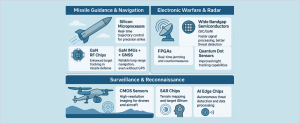
Electronics warfare and Radar: Electronic warfare (EW) and radar systems, built on different semiconductor technologies, form the key driver of battlefield dominance. Integrated circuits (ICs) fabricated using technologies such as CMOS, GaN, GaAs, and SiGe enable operation across low-frequency digital domains and high-frequency bands—from L-band to millimetre-wave. These technologies support critical functions like signal detection, response generation, and countermeasures, enabling fast RF transmission, real-time processing, and agile control essential for modern EW and radar systems.
At the front end, GaN-based high electron mobility transistors (HEMTs) in monolithic microwave integrated circuits (MMICs) deliver high-power RF amplification with good thermal efficiency, key for long-range radar and jamming. These are paired with low-noise amplifiers (LNAs), often made using SiGe BiCMOS or pHEMT processes, to ensure high sensitivity and signal integrity. RF switches and phase shifters, built on SOI or RF MEMS, enable dynamic beam steering in AESA radars, allowing electronic scanning without moving parts.
High-speed analogue-to-digital (ADC) and digital-to-analogue converters (DAC), typically CMOS or bipolar, digitise wideband signals for baseband processing. Radiation-hardened FPGAs and DSP cores handle FFTs, beamforming, and adaptive filtering. PLL synthesisers and VCOs, using SiGe or advanced CMOS, provide low-jitter, frequency-agile clocking critical for threat detection and deception. Together, these semiconductor components form the backbone of radar and EW systems, delivering precision, speed, and resilience in modern electromagnetic warfare.
Guidance and Navigation: In modern missiles and drones, guidance and navigation rely heavily on semiconductor-based components that ensure precision and reliability even in challenging environments. At the core of these systems are inertial navigation systems (INS), which use MEMS accelerometers and gyroscopes to measure motion and orientation without external signals, crucial for operation in GPS-denied conditions. These are often integrated into compact IMUs (Inertial Measurement Units) that fuse data in real time to calculate position and velocity. When GPS signals are available, GNSS receiver chips provide absolute positioning by processing satellite signals, with advanced modules incorporating anti-jamming and anti-spoofing features to maintain accuracy under electronic warfare. Complementing these are digital signal processors (DSPs) and microcontrollers (MCUs), which handle sensor data processing, flight control algorithms, and real-time decision-making. These systems typically utilise semiconductor technologies such as CMOS for GNSS and signal processing ICs, MEMS processes for inertial sensors, and advanced packaging to integrate these functions in compact, rugged modules. Together, these semiconductor components enable autonomous, accurate, and adaptive navigation critical to modern missile and UAV operations.
Explore how we at Orbit & Skyline help global FABs and system integrators by supporting GaN process optimisation, enabling better RF and radar performance. Read our related post on GaN in semiconductors here.
Surveillance and Reconnaissance: Surveillance and reconnaissance systems today use many types of semiconductor technologies for sensing, data processing, and secure communication. CMOS and CCD image sensors are used in electro-optical and night vision equipment. For thermal and FLIR imaging, infrared detectors made from materials like InGaAs, HgCdTe, and InSb are combined with special Readout ICs (ROICs). In radar systems, GaN HEMT chips are used in power amplifiers to send signals efficiently, while SiGe or pHEMT-based LNAs help in receiving weak signals clearly.
High-speed ADCs and DACs made using CMOS or BiCMOS are used to convert radar signals, including those from Synthetic Aperture Radar (SAR), into digital form for further analysis. SAR provides clear images even at night or in bad weather. Systems use FPGAs, SoCs, and AI chips, often made with advanced FinFET technology, to process this data quickly. AI edge ICs make fast, low-power decisions on the spot. DRAM and SRAM store sensor data, while secure MCUs and RF transceivers enable encrypted, high-speed communication. Together, these semiconductor parts help satellites, aircraft, and drones deliver accurate, real-time battlefield information.
Tiny Chips, Big Defence
Semiconductors also serve as a shield for nations, not just for those using advanced weapons, but especially for those that develop them. While many countries can buy defence systems, only a few can design and manufacture the complex semiconductor ICs inside them. These ICs are classified as commercial, military, or space-grade, with increasing reliability and performance demands. Military systems often operate in extreme conditions from -40°C to 150°C, requiring robust, fail-proof chips. Access to such military-grade ICs is restricted by various regulations and export controls. Hence, having a domestic, secure semiconductor manufacturing ecosystem is critical. Without it, countries risk supply-chain disruptions during strategic needs. These ICs function as sensory organs; eyes, ears, and brains of missiles, drones, and UAVs, and are essential for mission success.
A nation with precision-strike capabilities can deter adversaries from engaging in prolonged conflict, something seen very clearly in recent global conflicts. These semiconductor-driven systems form a “Silicon Shield,” reducing the impact of warfare on civilians and infrastructure. Compared to the devastation of the World Wars, recent conflicts have seen far less destruction, underlining the value of precision weapons in enabling restrained and strategic military actions.
The post Silicon Shield: Role of Semiconductors in Modern Warfare appeared first on ELE Times.
Андрій Макарчук: "Всебічна комунікація завжди приносить результат"

Наприкінці минулого року вийшов наказ МОН про призначення академічних стипендій Президента України аспірантам на 2025/2026 навчальний рік. Її отримають здобувачі, які мають видатні наукові чи навчальні досягнення, як заохочення їхньої діяльності та мотивацію до високих результатів. Серед нагороджених і Андрій Макарчук, асистент кафедри інженерії програмного забезпечення в енергетиці НН ІАТЕ.
Silicon Photonics: The Lightspeed Revolution That Will Transform AI Computing
Courtesy: Lam Research
Lam Research is setting the agenda for the wafer fabrication equipment industry’s approach to a silicon photonics revolution, driving the breakthroughs in Speciality Technologies that will enable sustainable AI scaling through precision optical manufacturing.
The artificial intelligence boom has created an energy crisis that threatens to consume more electricity than entire nations. As data centres race to keep pace with AI’s insatiable appetite for computational power, technology leaders like Lam are shaping a fundamental shift that could redefine how we think about high-performance computing. One solution lies in replacing the electrical interconnects that have powered computing for decades with something far more efficient: light.
AI’s Energy Crisis: Why Power Demand Is Surging in Data Centres
Goldman Sachs projects a 160% increase in data centre power demand by 2030, reaching 945 terawatt-hours annually — equivalent to Japan’s entire electricity consumption.
The problem runs deeper than software inefficiency. According to Bloomberg, AI training facilities house hundreds of thousands of NVIDIA H100 chips, each drawing 700 watts, nearly eight times the power consumption of a large TV. Combined with cooling systems, some hyperscale facilities now require as much power as 30,000 homes, driving tech companies to seriously consider dedicated nuclear plants.
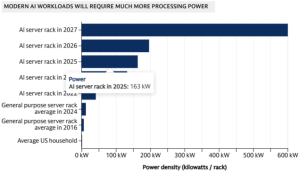 Source: Nvidia. Apart from average estimates, power data for racks are based on Nvidia specifications. 2025 and later are estimates. AI server racks refer to GPU racks. General-purpose racks refer to CPUs.
The Paradigm Shift
Meeting this challenge requires a fundamental change in how chips are designed and connected. Silicon photonics—using light to transmit data—has the potential to provide dramatic improvements in speed and efficiency over traditional electrical interconnects. Precision optical manufacturing makes this shift possible, enabling scalable processes that can support the next era of energy-efficient, high-performance computing.
Silicon photonics represents a fundamental reimagining of how data moves within computing systems. Instead of pushing electrons through copper wires, this technology uses photons—particles of light—to carry information through silicon waveguides that function like nanoscale fibre optic cables, integrated directly onto chips.
The efficiency gains are dramatic. Optical interconnects consume just 0.05 to 0.2 picojoules per bit of data transmitted, compared to the much higher energy requirements of electrical interconnects over similar distances. As transmission distances increase, even within a single package, the energy advantage of photonics becomes overwhelming.
TSMC has published several research papers on silicon photonics since late 2023. The company has announced public partnerships with NVIDIA to integrate optical interconnect architectures into next-generation AI computing products. Lam is leading the industry’s approach to the transition to silicon photonics. As a technology leader with deep expertise in precision manufacturing, we are defining the roadmap for silicon photonics production, working closely with leading foundries and fabless companies to address the unique challenges presented by optical interconnects.
According to Yole Group, the market for silicon photonics is expected to grow from $95 million in 2023 to more than $863 million in 2029, with a 45% annual growth rate that reflects the technology’s expected rapid commercial adoption.
The Limits of Copper: Why Traditional Interconnects Can’t Scale With AI
At the heart of this energy crisis lies a fundamental bottleneck that has been building for years. While computing performance has advanced at breakneck speed, the infrastructure connecting these powerful processors has not kept pace. Hardware floating-point operations (FLOPS) have improved 60,000-fold over the past two decades, but DRAM bandwidth has increased only 100-fold, and interconnect bandwidth just 30-fold over the same period.
This creates what engineers call the “memory wall,” a constraint where data cannot move between processors and memory fast enough to fully use the available computing power. In AI applications, where massive datasets must flow seamlessly between graphics processors, high-bandwidth memory, and other components, these interconnect limitations become critical performance bottlenecks.
The solution that worked for previous generations—simply shrinking copper interconnects and packing them more densely—is reaching physical limits. As these copper traces become smaller and more numerous, they consume more power, generate more heat, and introduce signal integrity issues that become increasingly difficult to manage. Each voltage conversion in a data centre’s power delivery system introduces inefficiencies, and copper interconnects compound these losses throughout the system.
Modern AI architectures require what engineers call “high access speeds within the stack.” Chips become thinner, interconnects evolve from through-silicon vias (TSVs) to hybrid bonding, and memory modules must connect directly to graphics processors at unprecedented speeds. But when that high-speed memory connection has to traverse copper tracks on a circuit board to reach another processor, much of the bandwidth advantage disappears.
Silicon Photonics Meets AI: Co-Packaged Optics for Next-Gen Performance
Silicon photonics is not entirely new; it has powered telecommunications networks for years through pluggable transceivers that connect data centre racks. These proven systems use silicon photonic dies combined with separate lasers and micro-lens technologies packaged into modules that can be easily replaced if they fail.
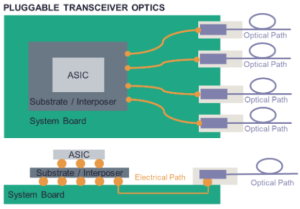
But AI’s demands are pushing photonics into uncharted territory. Instead of simply connecting separate systems, the technology must now integrate directly with processors, memory, and other components in what engineers call “co-packaged optics.” This approach promises to bring optical interconnects closer to the actual computation, maximising bandwidth while minimising energy consumption.
The challenge is reliability. While pluggable transceivers can be easily swapped out if they fail, co-packaged optical systems integrate directly with expensive graphics processors and high-bandwidth memory, making them a more reliable option. If an optical component fails in such a system, the repair becomes exponentially more complex and costly. Early implementations from major chip developers are still in pilot phases, carefully assessing long-term reliability before full-scale deployment.
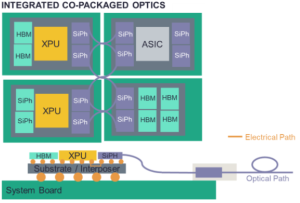
Accelerating Adoption: How Industry Timelines Are Moving Faster Than Expected
Industry roadmaps that once projected capabilities for 2035 are already being met by leading manufacturers. The combination of urgent market need, massive investment, and three decades of accumulated photonics research has created what amounts to a perfect storm for commercialisation.
The implications extend far beyond data centres. As optical interconnects become more cost-effective and established, they have the potential to revolutionise everything from autonomous vehicles to edge computing devices. The same technology that enables sustainable AI scaling could ultimately transform how electronic systems communicate across virtually every application.
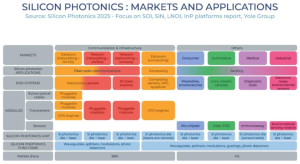 Source: Yole Group
The Future of Computing Is Optical Interconnects for Sustainable AI Growth
The question is how quickly it can be implemented and scaled. With leading manufacturers already investing billions and pilot systems entering data centres, the light-speed future of computing is no longer a distant possibility. Companies like Lam, through our customer-centric approach and advanced manufacturing solutions, enable this transformation by providing the precision tools that make commercial silicon photonics possible.
Silicon photonics represents a fundamental technology shift that could determine which companies lead the next phase of the digital revolution. Just as the introduction of copper interconnects enabled previous generations of performance scaling, optical interconnects have the potential to break through the barriers that threaten to constrain AI development.
For an industry grappling with the sustainability challenges of exponential AI growth, silicon photonics offers a path forward that doesn’t require choosing between performance and environmental responsibility. By replacing electrical inefficiency with optical precision, this technology could enable the continued advancement of AI while dramatically reducing its environmental footprint.
The revolution is just beginning, but one thing is clear: the future of high-performance computing is increasingly bright, and Lam is at the centre of it.
The post Silicon Photonics: The Lightspeed Revolution That Will Transform AI Computing appeared first on ELE Times.
Сторінки




![[link]](https://i.redd.it/9j8ugm3zdphg1.png)